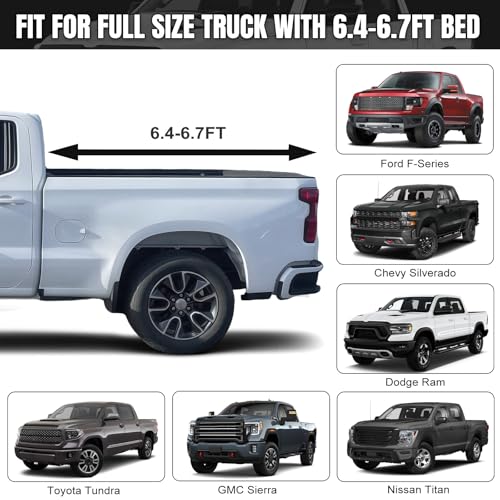
A 10 x 12-foot tarp is a useful starting point for many full-size pickup beds, while an 8 x 10-foot tarp may work for some smaller beds. The right size depends on your truck’s measurements, cargo height, and the amount of fabric needed for tie-downs.
Pickup trucks are common on American roads, from Ford F-150s and Chevrolet Silverados to Toyota Tacomas and Nissan Frontiers. Many owners use a tarp to protect tools, camping gear, furniture, and other cargo from rain, dust, and road debris. However, buying the wrong size can leave part of the load exposed or create loose fabric that flaps in the wind.
The best way to choose a tarp is to measure the truck bed and the cargo you plan to carry. A truck with a 5.5-foot bed may need a larger tarp when carrying tall furniture than when covering an empty bed. The extra fabric must also reach the tie-down points without dragging on the road.
This guide explains how to measure a pickup bed, calculate the needed tarp dimensions, and choose a suitable size for different truck types. It also covers tarp materials, tie-down methods, common sizing mistakes, and important road safety checks.
The tarp size depends on the truck bed and what you want to cover. For many pickup owners, an 8 x 10-foot tarp or a 10 x 12-foot tarp is a useful starting point. A larger 12 x 16-foot tarp may be needed for tall cargo, extra side coverage, or a longer truck bed.
These sizes are starting estimates, not universal fit specifications. Pickup beds vary by model, cab style, model year, and trim. Even two trucks from the same manufacturer can have different bed lengths.
The easiest way to avoid a poor fit is to measure the truck and cargo first. Think of the tarp as a sheet that must travel over the top of the load and hang far enough down each side to reach secure tie-down points.
Source: aequitech.com
Compact pickup trucks
An 8 x 10-foot tarp may work for a compact pickup with a modest load. Check the bed width and the amount of fabric needed at the front and rear.
Mid-size pickup trucks
An 8 x 10-foot or 10 x 12-foot tarp may fit, depending on the bed length, cargo height, and desired overlap.
Full-size pickup trucks
A 10 x 12-foot tarp is a useful starting point for many ordinary loads. A larger tarp may be needed when cargo rises well above the bed rails.
Long-bed pickup trucks
A 10 x 12-foot or larger tarp may be more suitable, but calculate the required dimensions before choosing.
Quick Truck Bed Tarp Size Guide
The following table gives practical starting points for shopping. It does not replace measuring your exact truck. The suggested sizes assume a simple draped tarp and a modest amount of cargo rather than a tall or unusually wide load.
Small bed
Consider an 8 x 10-foot tarp if it provides enough coverage and tie-down room.
Standard mid-size bed
Compare 8 x 10-foot and 10 x 12-foot options.
Short full-size bed
Start by checking a 10 x 12-foot tarp.
Long full-size bed
Compare 10 x 12-foot and 12 x 16-foot options based on the load.
Understand Truck Bed Measurements Before Buying a Tarp
Truck bed measurements are the foundation of a good tarp fit. You need the usable length, width, and height of the load. Measuring only the bed floor can lead to a tarp that covers the center but does not reach the sides.
Most pickup bed sizes are described by their approximate length. Common labels include short bed, standard bed, and long bed. These labels are useful for comparing trucks, but they are not exact measurements.
For example, a short bed may measure around 5.5 feet, while other pickups offer beds near 6.5 feet or 8 feet. Actual dimensions differ by vehicle. Ford’s F-150 specifications provide one example of a truck offered with several bed lengths, which shows why checking the exact model matters.
Measure the bed from the inside of the front wall to the inside edge of the closed tailgate. Then measure the width between the inside bed walls. If the bed narrows near the wheel wells, record that narrower measurement too.
Source: snapklik.com
Bed length
Measure from the front bed wall to the closed tailgate. Do not rely only on the advertised bed category.
Bed width
Measure between the inside bed walls. Also check the narrowest point around the wheel wells.
Cargo height
Measure from the bed floor to the highest point of the load. This determines how much fabric must hang down the sides.
Tie-down distance
Check where the tarp can be attached securely. You need enough fabric to reach the chosen attachment points.
Why Truck Bed Width Matters
A tarp must cover the width of the load and provide enough material for both sides. A bed may have a different width at the floor than at the top of its side rails. Cargo can also extend beyond the bed walls, making the required tarp wider.
Measure the widest part of the cargo rather than assuming the truck bed walls define the full coverage area. This is especially important when carrying furniture, boxes, or outdoor equipment.
Measure the widest area
Include cargo that extends beyond the normal bed footprint.
Check both sides
Make sure the tarp has enough material to reach suitable attachment points on the left and right.
How to Calculate the Correct Tarp Size for Your Truck Bed
You can calculate the tarp size with a simple measurement method. Start with the cargo footprint, then add the fabric needed to hang down each side and end. Finally, allow some extra material for the tie-down system.
The important point is that tarp dimensions must account for the full path over the cargo. A tarp that matches the flat bed dimensions will usually be too small if it also needs to cover the sides.
Source: toptonneaucover.com
Step 1: Measure the cargo length
Measure the longest part of the load from front to back. Include any item that extends beyond the normal bed area.
Step 2: Measure the cargo width
Find the widest point from left to right. Use the load width if it is wider than the truck bed.
Step 3: Measure the side drop
Measure how far the tarp must hang from the top of the load to the planned tie-down area. Use the same method for the front and rear drops.
Step 4: Add the extra coverage
Add the front and rear drops to the cargo length. Add the left and right drops to the cargo width.
Step 5: Allow for attachment
Include the extra fabric needed for reinforced edges, grommets, hooks, and secure fastening. Follow the tarp maker’s guidance.
The Simple Tarp Size Formula
For a basic rectangular load, use these formulas as a planning tool. They assume a flat tarp draped over the load, with a similar drop on opposite sides.
Tarp length
Cargo length + front drop + rear drop + any extra end allowance.
Tarp width
Cargo width + left-side drop + right-side drop + any extra side allowance.
Example Calculation for a Full-Size Pickup
Suppose your pickup has a cargo area that measures 66 inches long and 50 inches wide. You want the tarp to hang 12 inches down each side and each end. You also plan an extra 12 inches of total allowance in each direction for fastening and adjustment.
The length calculation is 66 + 12 + 12 + 12 = 102 inches. That is 8.5 feet. The width calculation is 50 + 12 + 12 + 12 = 86 inches, or about 7.2 feet.
A tarp around 8 x 10 feet may be a reasonable option for this hypothetical setup, depending on its actual finished dimensions and attachment points. If the load becomes taller or wider, you will need to calculate again.
Length required
Approximately 102 inches, or 8.5 feet.
Width required
Approximately 86 inches, or 7.2 feet.
Possible shopping size
Compare a 10 x 8-foot tarp and confirm the finished size provides enough usable coverage.
What Tarp Size Works for Different Pickup Trucks?
Different pickup trucks need different tarp dimensions because their beds vary in length, width, and shape. A tarp that fits one short-bed truck may not cover another truck with a wider cargo area.
Use the truck’s actual measurements instead of choosing by brand alone. The Ford F-150, Chevrolet Silverado 1500, Ram 1500, Toyota Tacoma, Nissan Frontier, and GMC Sierra all have different bed configurations across their model ranges.
Source: rackreveal.com
Ford F-150
Measure the exact 5.5-foot, 6.5-foot, or 8-foot bed configuration where applicable. A 10 x 12-foot tarp is a starting option for many ordinary loads, not a guaranteed fit.
Chevrolet Silverado 1500
Check the specific bed configuration and width. Compare 10 x 12-foot and larger tarps if the load needs substantial side coverage.
Ram 1500
Measure the cargo area and any load extending above the rails. Choose a tarp based on the actual coverage path.
Toyota Tacoma
A smaller tarp may work for a modest load, but the bed length and cargo height should guide the final choice.
Nissan Frontier
Check the bed dimensions for the exact cab and model configuration before buying.
GMC Sierra
Compare the exact bed size and cargo profile. Do not assume that a tarp sold for a similar Chevrolet model will fit every setup.
Short Bed vs. Long Bed Tarp Sizes
A short bed needs less fabric along its length than a long bed, assuming both carry loads of similar height and width. However, the same short bed may need a larger tarp if you carry a tall load that requires longer side drops.
A long bed may need more fabric at both ends. A 10 x 12-foot tarp could be suitable for some setups, but a larger size may be needed when the load is tall or the attachment points sit far below the top of the cargo.
Short bed
Start by comparing 8 x 10-foot and 10 x 12-foot options.
Standard bed
Compare 10 x 12-foot options against your calculated dimensions.
Long bed
Check 10 x 12-foot and 12 x 16-foot options when extra length or side coverage is needed.
Choose the Right Tarp Material for Truck Bed Protection
Tarp material matters almost as much as tarp size. A correctly sized cover can still fail to protect your cargo if the fabric tears, allows water through, or wears against sharp edges.
For everyday pickup use, polyethylene and canvas are common options. Vinyl-coated materials are also available for demanding jobs. Each type has different strengths, so consider how often you use the tarp and what kind of weather it must handle.
Source: tytarp.com
Polyethylene tarps
These are often lightweight, affordable, and water-resistant or waterproof, depending on construction. They work well for general cargo protection and occasional use.
Canvas tarps
Canvas can be useful for certain work and storage needs. Its water resistance depends on treatment and construction, so check the product specifications.
Vinyl tarps
Vinyl-coated tarps can offer a tough, water-resistant cover for demanding applications. They may be heavier and harder to handle than basic polyethylene.
Mesh tarps
Mesh allows airflow and can help contain certain loads when properly designed and secured. It does not provide the same rain protection as a solid waterproof tarp.
What Does Tarp Thickness Mean?
Tarp thickness is often described in mils, while some manufacturers use fabric weight or GSM. One mil equals one-thousandth of an inch. GSM means grams per square meter and describes fabric weight rather than thickness alone.
A higher number does not automatically prove that a tarp is better for every truck. Material type, weave, coating, seams, edge reinforcement, and grommet quality all affect how well it performs.
For regular hauling, look for reinforced edges and strong attachment points. If you carry heavy or sharp cargo, protect the tarp from abrasion rather than relying on thickness alone.
Check reinforced edges
Strong hems can help reduce tearing around the perimeter.
Inspect the grommets
Look for secure metal or reinforced attachment points that suit your fastening method.
Check the coating
Confirm that the material is rated for the level of water protection you need.
How to Put a Tarp Over a Truck Bed Properly
A good tarp needs proper placement and secure attachment. Even a large tarp can become unsafe if it is loose, catches the wind, or allows cargo to move underneath it.
Before starting, park on level ground and inspect the cargo. Remove sharp objects that could cut the fabric, and make sure the load is within the truck’s rated capacity. Keep the tarp away from hot exhaust parts and moving components.
Source: snapklik.com
Step 1: Arrange the cargo
Place heavy items low and distribute the weight properly. Secure individual items with suitable cargo straps before adding the tarp.
Step 2: Position the tarp
Center the tarp over the cargo. Make sure it covers the front, rear, and both sides.
Step 3: Remove large loose sections
Fold or arrange excess fabric so it does not form large wind-catching pockets. Avoid sharp folds against rough metal edges.
Step 4: Attach the tarp
Use suitable straps, tarp fasteners, or rope with the truck’s rated attachment points. Spread tension across several reinforced areas.
Step 5: Check the rear
Make sure the tarp does not cover the tail lamps, turn signals, license plate, or other required equipment.
Step 6: Inspect the full cover
Walk around the truck and check for loose corners, exposed cargo, sharp edges, and possible contact with the tires.
How to Know If the Tarp Fits Correctly
A properly fitted tarp covers the intended cargo without being stretched beyond its limits. Its edges reach secure attachment points, and the fabric stays in place without large loose sections.
The tarp should not hang so low that it can contact the tires or road. It should also leave the driver’s view and vehicle lights clear. If the cover cannot meet these conditions, choose a different size or a suitable cargo cover system.
Good coverage
The cargo is covered on top and along the sides that need protection.
Secure attachment
The tarp remains firmly attached at several suitable points.
No dangerous movement
The fabric does not flap heavily or move toward the wheels during normal travel.
How to Secure a Truck Bed Tarp for Highway Driving
Highway driving creates strong airflow around a pickup truck. Loose tarp fabric can flap, tear, or pull free. This can expose cargo and create a road hazard for other drivers.
The National Highway Traffic Safety Administration advises drivers to secure cargo with rope, netting, or straps and to consider covering the entire load with a sturdy tarp or netting. It also stresses the need to double-check the load before driving.
A tarp should be treated as a protective cover, not as the main restraint for heavy cargo. Use properly rated tie-downs to keep individual items from shifting or falling. Follow the applicable federal and state cargo-securement requirements for your vehicle and load.
Source: sintesis.med.uchile.cl
Use suitable attachment points
Attach straps to approved truck bed anchors or other points designed to handle the load. Do not rely on plastic trim or decorative parts.
Distribute tension
Secure the cover at several points instead of pulling all the tension onto one grommet.
Protect sharp corners
Use suitable padding around sharp cargo edges to reduce the chance of cuts and abrasion.
Avoid loose fabric
Fold and secure excess material so it cannot catch the wind or reach the tires.
Check the load during travel
Stop in a safe location and inspect the cover and cargo when conditions or the journey make another check necessary.
Can You Use Bungee Cords to Secure a Truck Tarp?
Bungee cords can help hold the edges of some lightweight covers in place, but they should not be treated as a substitute for rated cargo restraints. Their stretch can allow the tarp to move, especially when exposed to strong airflow.
Use the fastening method recommended for the tarp and the truck. For road travel, select suitable straps and secure the actual cargo independently. Check that no hook or cord can come loose and become a hazard.
For light cover adjustment
Suitable elastic fasteners may help manage small sections of excess fabric when the manufacturer permits their use.
For cargo restraint
Use properly rated tie-down straps or other appropriate load-restraint equipment.
Common Mistakes When Choosing a Truck Bed Tarp
The most common sizing mistake is buying a tarp based only on the truck’s bed length. This ignores the fabric needed to cover the width, hang down the sides, and reach the tie-down points.
Another problem is buying a tarp that is much too large. Extra fabric may seem useful, but loose material can catch the wind, wear against the truck, and become difficult to secure. The goal is enough coverage without uncontrolled excess.
Source: desertcart.com.au
Choosing by bed category alone
Short bed and long bed labels are not exact measurements. Measure your own truck before buying.
Ignoring cargo height
A tarp that fits an empty bed may be too small for boxes, furniture, or equipment that rises above the rails.
Forgetting the tie-down allowance
A tarp needs enough material to reach secure attachment points. A tight fit can pull on the grommets and seams.
Buying a weak material
A thin, poorly reinforced cover may tear when exposed to sharp corners or repeated movement.
Using the tarp as the only restraint
A weather cover cannot automatically stop heavy cargo from moving during braking or sudden turns.
Leaving the tarp loose
Loose sections can flap in the wind, damage the fabric, and create road hazards.
What If Your Tarp Is Too Small?
If the tarp does not reach the attachment points, do not stretch it hard or force the grommets into position. This can damage the edges and leave parts of the cargo exposed.
Choose a larger tarp or a cover made for your particular load. If the tarp is only slightly short, do not assume that adding rope will make it safe. The entire cover must remain secure under the conditions in which you plan to drive.
Recheck your measurements
Measure the widest and tallest parts of the cargo again.
Choose the next suitable size
Compare the calculated dimensions with available finished tarp sizes.
Use a suitable alternative
Consider a purpose-built cargo cover or another appropriate system if a flat tarp cannot provide safe coverage.
What If Your Tarp Is Too Large?
A tarp that is too large can create folds and loose sections. Do not allow excess material to hang near the wheels, exhaust, or road. Fold it neatly and secure the folds using suitable attachment methods.
If you cannot remove the loose fabric safely, use a smaller tarp. A closer fit is often easier to inspect and maintain during a trip.
Fold excess fabric
Keep the folds away from moving and hot parts.
Check the corners
Make sure folded sections cannot open and catch the wind.
Tarp vs. Tonneau Cover: Which Is Better for a Truck Bed?
A tarp and a tonneau cover serve related but different purposes. A tarp is a flexible sheet that can cover different cargo shapes. A tonneau cover is a fitted truck bed cover designed for a particular vehicle or bed configuration.
Choose a tarp when you need flexible coverage for changing loads. It can cover boxes, furniture, outdoor gear, and cargo that sits above the bed rails. A tonneau cover is more suitable when you want a regular fitted cover for an empty or lightly loaded bed.
Neither option automatically guarantees complete waterproofing or theft protection. The result depends on the design, installation, condition, and how the cover is used.
Source: snapklik.com
Tarp flexibility
A tarp can adapt to many cargo shapes and can be removed or folded when not needed.
Tonneau cover fit
A tonneau cover is designed to fit the bed and may provide a cleaner appearance and more convenient daily access.
Cost considerations
Basic tarps often cost less than fitted covers, although heavy-duty materials and larger sizes can cost more.
Cargo height
A tarp can cover cargo that extends above the bed rails when sized correctly. Many fitted covers limit the available cargo height.
Storage
A tarp can be folded and stored when not in use, while a fitted cover stays attached or requires a separate removal process.
Which Option Should You Choose?
For occasional hauling, a suitable tarp can be a practical choice because it adjusts to different loads. For daily protection of an otherwise empty bed, a tonneau cover may be easier to use.
If you regularly carry tall cargo, check whether a tarp can be safely secured around that specific load. If you need a fitted cover for everyday use, compare the cover’s exact compatibility with your truck.
Choose a tarp
When you carry different types of cargo and need flexible coverage.
Choose a tonneau cover
When you want a regular fitted cover for everyday truck bed use.
Frequently Asked Questions
Q
Is a 10 x 12 tarp big enough to cover a truck bed?
A 10 x 12-foot tarp is large enough for many ordinary full-size pickup bed coverage jobs. However, it may not cover a tall or unusually wide load. Measure the bed, cargo height, and required side drops before choosing this size.
Q
What size tarp do I need for a 5.5-foot truck bed?
An 8 x 10-foot or 10 x 12-foot tarp may work for a 5.5-foot bed, depending on its width and the cargo height. A modest load may need less fabric than furniture or equipment that rises above the bed rails. Calculate the full coverage dimensions rather than relying on bed length alone.
Q
Can I use an 8 x 10 tarp on a full-size pickup?
Yes, an 8 x 10-foot tarp may cover some full-size pickup beds when the load is low and the measurements allow enough fabric for the sides and ends. It may be too small for a taller load or a long bed. Check the actual finished tarp dimensions before buying.
Q
How much should a tarp hang over the sides of a truck bed?
The tarp should hang far enough to reach secure attachment points below or around the load without becoming loose. The required drop depends on cargo height, bed design, and fastening method. Measure the distance from the top of the load to the planned attachment point on both sides.
Q
What is the best material for a truck bed tarp?
Polyethylene is a common choice for general cargo protection because it is often lightweight and affordable. Heavy-duty vinyl can suit demanding work, while canvas may work for specific storage and hauling needs. Compare water resistance, fabric weight, edge reinforcement, and grommet quality before choosing.
Q
Can I drive on the highway with a tarp over my truck bed?
You can transport covered cargo when the load and cover are secured properly and comply with applicable laws. Use suitable tie-downs to restrain the cargo, keep the tarp from flapping, and make sure vehicle lights and the license plate remain visible. Stop in a safe place if the cover becomes loose.
Q
Can a tarp protect a truck bed from heavy rain?
A waterproof tarp can help protect cargo from rain when it is correctly fitted and secured. However, water may enter through loose edges, openings, seams, or gaps around the cargo. Arrange the tarp so water can drain rather than collect in deep pockets.
✦ Wrapping Up
Conclusion
The right tarp size for a truck bed depends on the bed dimensions, cargo height, and amount of material needed for secure attachment. An 8 x 10-foot tarp may work for some smaller or modest loads, while a 10 x 12-foot tarp is a useful starting point for many full-size pickups. Larger loads may need a 12 x 16-foot tarp or another size based on careful measurements.
Do not buy a tarp based only on the truck’s short-bed or long-bed label. Measure the actual cargo area, calculate the side and end drops, and allow enough material for the fastening system. Also consider fabric strength, reinforced edges, and weather protection.
Most importantly, keep cargo restraint separate from weather protection. Secure heavy items with suitable tie-down equipment, fasten the tarp at appropriate points, and check the entire load before driving. A properly sized and secured tarp can help protect your cargo while keeping your trip safer.
💡 Key Takeaway
Measure your truck bed and the highest point of your cargo before shopping. Calculate the required length and width, compare the result with available tarp sizes, and choose a cover that reaches secure tie-down points without loose fabric.