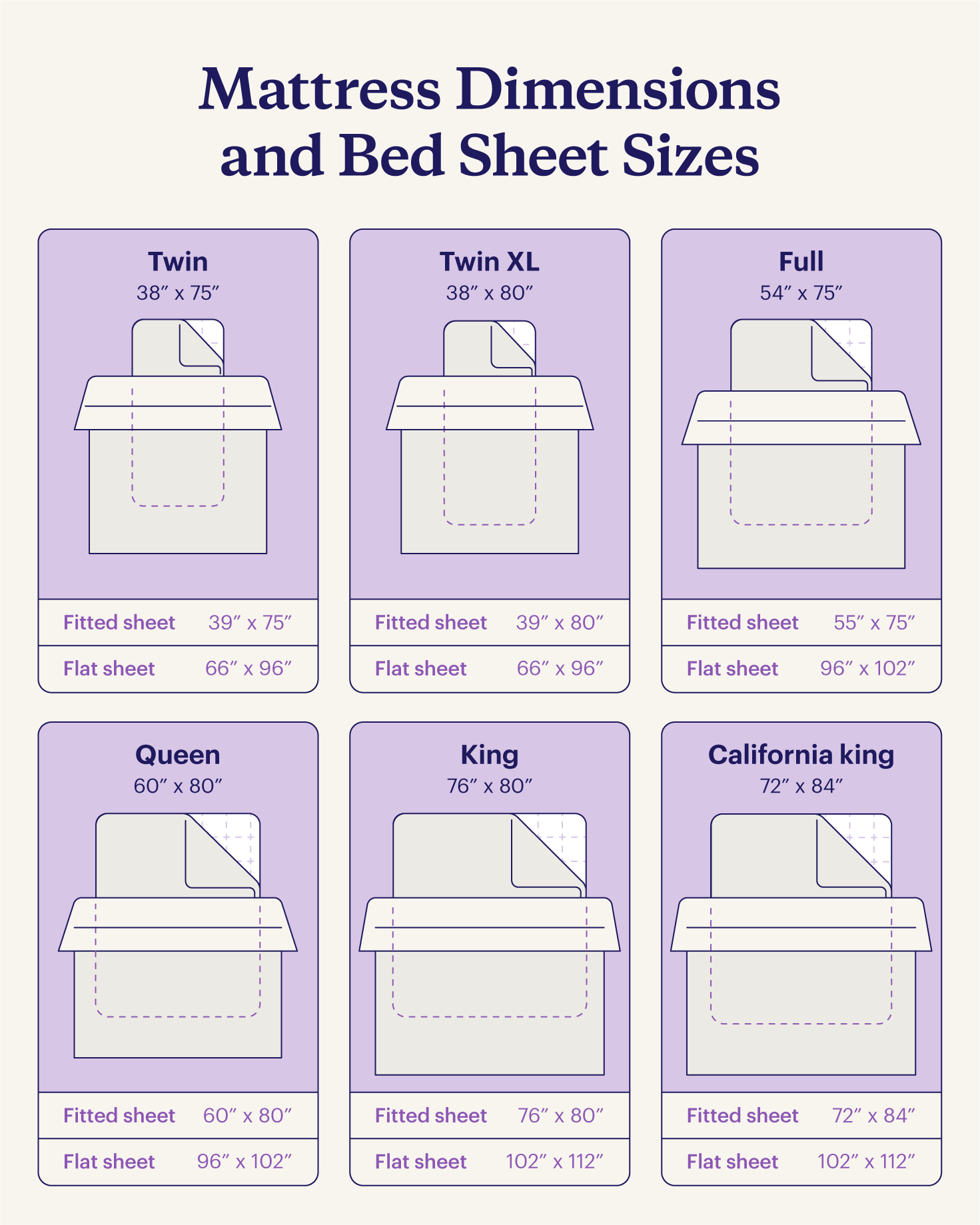
Full bed sheets are made for a mattress measuring 54 inches wide by 75 inches long. A typical full fitted sheet measures about 54 x 75 inches, while a full flat sheet commonly measures between 84 x 96 and 92 x 112 inches, depending on the brand.
In American homes, a full bed is a common choice for guest rooms, small bedrooms, apartments, and college housing. It offers more room than a twin mattress without taking up as much floor space as a queen bed. When shopping at US bedding stores, you may also see this size called a double bed.
However, knowing your mattress size is only the first step. Fitted sheets, flat sheets, and pillowcases all have different measurements. A fitted sheet must wrap around the mattress, while a flat sheet needs extra fabric to cover the sleeper and hang over the sides.
Mattress thickness also matters. A sheet that matches the width and length but has shallow pockets may pull off the corners during the night. Mattress toppers and thick protective pads can make this problem worse.
This guide explains standard full bed sheet dimensions, how each sheet works, and how to measure your mattress before buying. You will also learn the difference between full and queen bedding, how much pocket depth you need, and what to check when a sheet does not fit.
What Are the Standard Dimensions of Full Bed Sheets?
Full bed sheets are designed to cover a full-size mattress, which measures 54 inches wide and 75 inches long. This is the standard US mattress measurement. The full size is also known as a double bed.
The important difference is that not every sheet in a full bedding set has the same dimensions. A fitted sheet follows the mattress measurements, while a flat sheet is much larger because it must cover the top and provide enough fabric for the sides.
There is no single flat sheet measurement used by every US bedding brand. Some manufacturers make wider sheets for extra coverage, while others use smaller dimensions to create a closer fit.
Source: assets.weimgs.com
Full mattress
54 inches wide by 75 inches long.
Full fitted sheet
Usually around 54 x 75 inches across the mattress surface, plus a pocket for mattress depth.
Full flat sheet
Common examples range from approximately 84 x 96 inches to 92 x 112 inches.
Full pillowcase
A standard pillowcase often measures approximately 20 x 26 inches, although brand measurements vary.
Full Bed Sheet Size in Inches and Centimeters
US bedding measurements usually appear in inches. If you are comparing American bedding with products sold in countries that use the metric system, converting the numbers can make shopping easier.
One inch equals 2.54 centimeters. Therefore, a 54 x 75-inch full mattress measures about 137 x 191 centimeters. These are the mattress dimensions, not the complete measurements of every sheet.
Width
54 inches, approximately 137 centimeters.
Length
75 inches, approximately 191 centimeters.
Surface area
4,050 square inches, calculated by multiplying 54 by 75.
Why Full Beds Are Also Called Double Beds
The terms full and double generally describe the same standard US mattress size. Both refer to a mattress measuring 54 x 75 inches.
This means that a bedding package labeled double may fit a standard full mattress. Still, check the actual measurements before purchasing because international double sizes and some specialty products may differ.
Full
The common modern US name for a 54 x 75-inch mattress.
Double
An alternative name commonly used for the same US mattress size.
Full Fitted Sheet Dimensions Explained
A full fitted sheet usually measures approximately 54 inches wide by 75 inches long across the mattress surface. It also has elastic edges and fabric pockets that wrap around the mattress corners.
Unlike a flat sheet, a fitted sheet must stay in place while you sleep. Its corners stretch around the mattress, and the elastic helps hold the fabric underneath the edges.
The pocket depth is just as important as the width and length. A full mattress may have the correct standard surface dimensions but still be too thick for a regular fitted sheet.
Source: alanmossny.com
Width and length
Look for a fitted sheet made for a 54 x 75-inch full mattress.
Pocket depth
Check how thick a mattress the fitted sheet can accommodate.
Elastic design
A secure elastic edge helps keep the corners in place.
Fabric stretch
Some knitted fabrics stretch more than woven fabrics, but stretch does not replace correct sizing.
What Is the Pocket Depth of a Full Fitted Sheet?
Pocket depth refers to how far the fitted sheet extends down the sides of a mattress. It determines whether the sheet can wrap around the mattress and reach underneath its edges.
Standard, deep, and extra-deep are common product labels. However, these labels do not have one fixed measurement across all bedding brands. One company may call a 14-inch pocket deep, while another may use a different category.
Many standard fitted sheets accommodate mattresses around 7 to 12 inches thick. Deep-pocket options often accommodate thicker mattresses, but the exact fit range must come from the product description.
Standard pocket
Often intended for mattresses around 7 to 12 inches thick.
Deep pocket
Often designed for mattresses around 12 to 16 inches thick.
Extra-deep pocket
May accommodate mattresses around 16 to 20 inches thick or more, depending on the brand.
How to Choose the Right Pocket Depth
Start by measuring the total height of the bed layers that will sit inside the fitted sheet. Include the mattress protector and any topper that normally stays on the bed.
For example, suppose your mattress is 12 inches thick and your topper adds another 3 inches. Your fitted sheet needs to accommodate a 15-inch stack, not just the original mattress.
Look for a product that states its maximum compatible mattress depth. A little extra room may help the sheet wrap underneath the mattress, but too much loose fabric can also affect the fit.
Measure the complete stack
Include the mattress, protector, and topper.
Check the product limit
Compare your measurement with the manufacturer’s stated maximum mattress depth.
Check the corners
The elastic should reach underneath the mattress without excessive pulling.
Full Flat Sheet Dimensions and Measurements
A full flat sheet is larger than a fitted sheet because it must cover the sleeping surface and extend over the sides and ends of the mattress. Common full flat sheet measurements include 84 x 96 inches, 90 x 102 inches, and 92 x 112 inches.
These differences are normal. Bedding manufacturers use different amounts of extra fabric based on their designs, materials, and intended coverage.
A larger flat sheet can provide more fabric for tucking under the mattress. This can be helpful if you move around during sleep or prefer a neatly tucked bed.
Source: i.pinimg.com
84 x 96 inches
A compact full flat sheet measurement used by some manufacturers.
90 x 102 inches
A larger option that provides additional side and end coverage.
92 x 112 inches
Another common brand-specific full flat sheet measurement with generous coverage.
How Much Should a Full Flat Sheet Hang Over the Sides?
The amount of fabric hanging over the sides depends on the sheet width, mattress width, and mattress thickness. A wider sheet usually provides more coverage and more fabric for tucking.
For a simple example, consider a 90-inch-wide flat sheet on a 54-inch-wide mattress. The extra width is 36 inches. If centered evenly, that provides about 18 inches of extra fabric on each side before accounting for mattress thickness and any tuck underneath.
This is a basic calculation rather than a guaranteed hanging measurement. The mattress height and the way you make the bed will change the final result.
Choose more coverage
Look for a wider flat sheet if you prefer extra fabric along the sides.
Consider mattress thickness
A thicker mattress uses more fabric as the sheet passes down its sides.
Think about tucking
A longer sheet may be more useful if you tuck the bottom edge beneath the mattress.
Can You Use a Full Flat Sheet as a Top Sheet?
Yes. A full flat sheet is commonly used as a top sheet between the sleeper and the comforter or blanket. It creates a washable layer that can be changed without washing the heavier bedding as often.
Place the finished or decorative side facing down if you want the preferred side to show when you fold the top edge over the blanket. The exact arrangement depends on your bedding style.
Daily comfort
A flat sheet creates a light layer between your body and the comforter.
Easy washing
It can be washed separately from bulky bedding.
Full Bed Sheet Size Chart
A size chart makes it easier to compare the mattress with the bedding designed to cover it. The table below shows common US measurements for full bedding and nearby mattress sizes.
Fitted sheet dimensions are approximate surface measurements and do not include pocket depth. Flat sheet dimensions are examples because manufacturers do not all use the same standard.
Source: i.pinimg.com
Important measurement rule
Width comes first and length comes second in the measurements shown below.
Full Bed and Other Common US Bedding Dimensions
Use this comparison to identify the correct mattress category before purchasing sheets. Always check the manufacturer’s specific measurements for the fitted and flat pieces.
Full mattress
54 x 75 inches.
Full fitted sheet
Approximately 54 x 75 inches, plus pocket depth.
Full flat sheet
Approximately 84 x 96 to 92 x 112 inches, depending on the brand.
Full pillowcase
A standard pillowcase is often about 20 x 26 inches.
Full Sheets vs Twin, Queen, and King Sheets
Full sheets are not interchangeable with every other bedding size. The most important differences are mattress width and length, although pocket depth also affects whether a fitted sheet stays in place.
A full mattress is 16 inches wider than a standard twin mattress. It is also 6 inches narrower and 5 inches shorter than a queen mattress.
A king mattress is much wider than a full mattress. Using king bedding on a full bed may create excessive loose fabric, especially with a fitted sheet.
Source: designingidea.com
Twin
38 x 75 inches. It has the same standard length as a full mattress but is narrower.
Full
54 x 75 inches. It offers more width than a twin mattress.
Queen
60 x 80 inches. It is wider and longer than a full mattress.
King
76 x 80 inches. It offers much more sleeping width than a full bed.
California king
72 x 84 inches. It is narrower than a standard king but longer.
Can Queen Sheets Fit a Full Bed?
Queen flat sheets can usually be used on a full bed because they are larger than full flat sheets. The extra fabric may hang farther over the sides and ends, but it does not usually prevent the sheet from covering the mattress.
Queen fitted sheets may also stretch over some full mattresses, but the fit is not ideal. A queen mattress measures 60 x 80 inches, compared with 54 x 75 inches for a full mattress.
The extra width and length can create loose fabric. This may cause the fitted sheet to shift, bunch up, or feel less secure while sleeping. Elastic design and pocket depth can change the result, so compatibility is not guaranteed.
Queen flat sheet on a full bed
Usually usable, although it may provide more fabric than necessary.
Queen fitted sheet on a full bed
May stretch over the mattress, but can fit loosely and shift.
Best option
Choose a fitted sheet specifically labeled for a full mattress.
Can Full Sheets Fit a Queen Bed?
Full fitted sheets are generally too small for a queen mattress. A queen bed is 6 inches wider and 5 inches longer, so the corners of a full fitted sheet may not reach properly.
Trying to stretch a small fitted sheet over a larger mattress can strain the elastic and seams. It may also pull the sheet away from the corners during sleep.
A full flat sheet may cover part of a queen mattress, but it may not provide enough fabric for comfortable side coverage or proper tucking. A queen sheet set is the better choice.
Fitted sheet
Use queen size rather than stretching a full fitted sheet.
Flat sheet
Choose queen size for more reliable coverage.
How to Measure Your Full Mattress for the Right Sheets
Measuring your mattress before buying sheets is the simplest way to avoid a poor fit. Do not assume that an old sheet set is the correct size just because it once fit your bed.
Mattresses can have different thicknesses, rounded corners, pillow tops, and added layers. A few careful measurements can help you choose a sheet that stays in place.
Source: purple.com
What you need
A flexible tape measure, a notepad, and access to the mattress edges.
What to measure
Record the mattress width, length, and total height with regular bedding layers.
Step 1: Measure the Mattress Width
Place the tape measure across the widest part of the mattress from one side edge to the other. Keep the tape straight and measure the mattress itself rather than the bed frame.
A standard full mattress should measure about 54 inches across. If your measurement is different, check the mattress label or manufacturer’s specifications before ordering bedding.
Measurement
Record the full width in inches.
Step 2: Measure the Mattress Length
Measure from the head of the mattress to the foot. Keep the tape along the sleeping surface and avoid including the headboard or bed frame.
A standard full mattress measures 75 inches long. This is the same length as a standard twin mattress.
Measurement
Record the full length in inches.
Step 3: Measure the Mattress Thickness
Measure vertically from the bottom edge to the highest point of the mattress. If the mattress has a pillow top or raised surface, measure the complete height rather than a lower seam.
Leave any mattress protector or topper in place if the fitted sheet will normally cover it. These layers increase the total height that the sheet must accommodate.
Include extra layers
Measure the mattress with its usual protector and topper.
Check the highest point
Use the full height of a pillow-top or uneven mattress.
Step 4: Compare Your Measurements With the Sheet Label
Once you have the width, length, and total depth, compare them with the fitted sheet specifications. Confirm that the sheet is designed for a 54 x 75-inch mattress and can accommodate your measured thickness.
Do not rely only on a label that says deep pocket. The actual maximum mattress depth is more useful because it tells you what the sheet is designed to fit.
Correct surface size
The fitted sheet should match the full mattress width and length.
Suitable pocket
The pocket must accommodate the mattress and its additional layers.
Secure corners
The elastic should sit beneath the mattress without excessive tension.
Why Do Full Fitted Sheets Keep Coming Off?
A fitted sheet that repeatedly slips off usually has a sizing, depth, elastic, or installation problem. The mattress may be too thick, the sheet may be too large, or the elastic may no longer hold its tension.
Before replacing the entire bedding set, check the most common causes. A small measurement error can make a sheet feel much worse than it should.
Source: assets.weimgs.com
Incorrect pocket depth
The sheet cannot reach far enough underneath a thick mattress.
Wrong mattress size
A queen or twin fitted sheet may not hold securely on a full mattress.
Worn elastic
Old elastic can lose its ability to grip the mattress corners.
Incorrect installation
The fitted sheet may not be positioned evenly around all four corners.
How to Fix a Fitted Sheet That Is Too Small
If the sheet barely reaches the mattress corners, check the mattress measurements first. A standard full fitted sheet should fit a mattress measuring 54 x 75 inches, provided the pocket depth is suitable.
If the mattress is thicker than the sheet allows, replace it with a deeper-pocket version. Do not keep forcing the corners into place because repeated stretching can put stress on the elastic and seams.
Check dimensions
Confirm the mattress is actually a standard full size.
Check thickness
Compare the complete mattress stack with the sheet’s fit range.
Replace if needed
Choose a correctly sized full fitted sheet with suitable pocket depth.
How to Fix a Fitted Sheet That Is Too Large
A fitted sheet that bunches up or feels loose may have too much surface fabric or an oversized pocket. Check whether the package actually lists full rather than queen dimensions.
Make sure each corner is placed correctly before assuming the sheet is defective. If the mattress is smaller than the fitted sheet’s intended size, a properly sized full sheet will usually provide a neater fit.
Recheck the label
Confirm that the product is intended for a full mattress.
Check all corners
Make sure the fitted sheet is evenly positioned.
Avoid excess fabric
Choose a sheet with the correct width, length, and pocket depth.
How to Choose Full Bed Sheets for Different Mattress Types
The best full bed sheet size depends on the mattress design, not just its width and length. Foam, hybrid, pillow-top, and traditional innerspring mattresses can have different heights and edge shapes.
A standard fitted sheet may work well on a thin mattress but fail on a thicker model. Check the manufacturer’s maximum mattress depth before choosing your bedding.
Source: alanmossny.com
Memory foam
Check the mattress height and account for any foam topper.
Hybrid mattress
Measure the full mattress because spring and foam layers can create a thicker design.
Pillow-top mattress
Measure the highest point of the padded surface.
Traditional innerspring
A standard pocket may work on thinner models, but confirm the actual height.
Full Sheets for Memory Foam Mattresses
Memory foam mattresses can have several layers and may be thicker than older basic mattresses. Their surface can also compress under pressure, so measure the height without pressing down on the foam.
If you use a foam topper, include it when measuring the total stack. This helps prevent the fitted sheet from pulling off the corners.
Measure without compression
Do not push down on the foam while measuring its height.
Include toppers
Measure every layer that the fitted sheet must cover.
Full Sheets for Pillow-Top Mattresses
Pillow-top mattresses have an added padded layer on their upper surface. This design can make the mattress taller and may create rounded edges that need additional fabric.
A deeper fitted sheet may be necessary even when the mattress width and length match standard full dimensions. Check the listed fit range rather than relying on the bed size alone.
Check total height
Measure from the bottom edge to the highest part of the pillow top.
Check pocket construction
Look for a fitted sheet designed for your mattress depth.
Full Sheets for Mattresses With Toppers
A mattress topper can add several inches to the height of a bed. This is one of the most common reasons an old fitted sheet stops fitting after a bedding upgrade.
For example, a 10-inch full mattress with a 3-inch topper creates a 13-inch stack before considering other layers. Choose a fitted sheet that can accommodate the complete setup.
Measure after adding the topper
Do not use the mattress-only measurement when shopping for fitted sheets.
Check the maximum fit
Make sure the sheet’s stated depth covers the complete stack.
What to Check Before Buying Full Bed Sheets
Before buying a full sheet set, check more than the size printed on the package. The fabric, pocket depth, care instructions, and included pieces can all affect how useful the set will be.
A little attention at the buying stage can save you from dealing with loose corners, short flat sheets, or pillowcases that do not fit your pillows.
Source: i.pinimg.com
Mattress compatibility
Confirm that the fitted sheet is designed for a standard full mattress.
Pocket depth
Check the maximum mattress thickness supported by the product.
Flat sheet size
Compare the actual width and length with your coverage preferences.
Pillowcase dimensions
Check whether the set includes standard or king pillowcases.
Care instructions
Review washing and drying directions to help reduce unwanted shrinkage.
Does Fabric Type Affect Sheet Size?
Fabric type can affect how sheets feel, stretch, and respond to washing. Cotton, polyester, microfiber, linen, and cotton blends may behave differently, even when their package dimensions are similar.
Woven cotton sheets usually have less stretch than many knitted fabrics. Some cotton fabrics may also shrink during washing, especially if care instructions are not followed.
Microfiber and polyester blends may have different stretch and shrinkage characteristics. However, fabric type does not change the mattress size. A full sheet still needs to fit a 54 x 75-inch mattress.
Cotton
A common bedding material. Check care instructions because some cotton sheets can shrink.
Microfiber
Often made from fine synthetic fibers and available in different fabric constructions.
Linen
A natural fabric that may soften with use and can have different dimensional behavior depending on its construction.
Cotton blends
Combine fibers with different properties, so the product label is important.
Should You Buy a Full Sheet Set or Individual Sheets?
A full sheet set is convenient when you need matching bedding. Many sets include one fitted sheet, one flat sheet, and two pillowcases, although the exact contents depend on the manufacturer.
Buying individual sheets can make sense when you already own a suitable flat sheet or need a replacement fitted sheet with deeper pockets. This approach also lets you choose different materials for different bedding pieces.
Sheet set
Useful when you want matching pieces in one purchase.
Individual fitted sheet
Useful when you need a particular pocket depth.
Individual flat sheet
Useful when you want more coverage or need to replace a worn top sheet.
Frequently Asked Questions
Q
What size are full bed sheets in inches?
A full fitted sheet is generally made for a mattress measuring 54 inches wide by 75 inches long. A full flat sheet commonly measures between 84 x 96 and 92 x 112 inches, depending on the manufacturer. Always check pocket depth for fitted sheets.
Q
Are full sheets the same as double sheets?
Yes. In standard US bedding, full and double usually refer to the same mattress size: 54 x 75 inches. However, international double mattress sizes can differ, so check the actual measurements when buying bedding from another country.
Q
Will full sheets fit a 54 x 75-inch mattress?
Yes. A full fitted sheet is designed for a standard 54 x 75-inch mattress. Make sure its pocket depth can accommodate the mattress thickness, including any protector or topper that sits beneath the sheet.
Q
Are full and queen sheets the same size?
No. A full mattress measures 54 x 75 inches, while a queen mattress measures 60 x 80 inches. Queen flat sheets may be used on a full bed, but queen fitted sheets can feel loose. Full fitted sheets are too small for most queen mattresses.
Q
What size flat sheet goes on a full bed?
Common full flat sheet sizes include 84 x 96, 90 x 102, and 92 x 112 inches. The exact dimensions depend on the manufacturer. Choose a larger sheet if you want more side coverage or extra fabric for tucking.
Q
What pocket depth do I need for full bed sheets?
The correct pocket depth depends on the complete height of your mattress and any additional layers. Measure the mattress with its regular protector and topper, then compare that measurement with the manufacturer’s stated maximum mattress depth.
Q
Can I use a full fitted sheet on a twin bed?
A full fitted sheet is larger than a twin mattress, which measures 38 x 75 inches. It may fit over the mattress, but the extra fabric can bunch up and shift. A twin fitted sheet will generally provide a more secure fit.
Q
Can two adults sleep on a full bed?
Two adults can share a full bed, but the sleeping space is limited. A full mattress provides 54 inches of total width, or about 27 inches per person when shared equally. A queen bed offers more room for couples.
Q
What size pillows fit full bed pillowcases?
Full bed sheets do not require a special pillow size. Standard pillows commonly measure around 20 x 26 inches and usually fit standard pillowcases. Check the pillowcase measurements because some brands use slightly different dimensions.
Q
Do full bed sheets shrink after washing?
Some sheets can shrink during washing and drying, especially certain cotton fabrics. The amount depends on fiber type, fabric construction, and care conditions. Follow the manufacturer’s washing and drying instructions to help preserve the original size.
✦ Wrapping Up
Conclusion
Full bed sheets are designed for a standard US mattress measuring 54 inches wide by 75 inches long. A fitted sheet generally matches these surface dimensions, while a flat sheet is much larger to provide enough fabric for covering and tucking.
The most important detail beyond width and length is fitted sheet pocket depth. A thick mattress, pillow top, protector, or topper can change the total height that the sheet needs to cover. Measuring these layers before shopping can prevent loose corners and frustrating fit problems.
Flat sheet measurements also vary between brands. Common full options include 84 x 96, 90 x 102, and 92 x 112 inches. There is no need to assume that every full sheet set uses identical dimensions.
When comparing bedding, check the actual product measurements, mattress compatibility, pocket depth, and care instructions. A correctly sized full sheet set should cover the mattress comfortably and stay in place without excessive pulling or loose fabric.
💡 Key Takeaway
Before buying full bed sheets, measure your mattress width, length, and total thickness. Look for a fitted sheet designed for a 54 x 75-inch full mattress with suitable pocket depth, then choose a flat sheet based on the amount of coverage and tucking room you prefer.