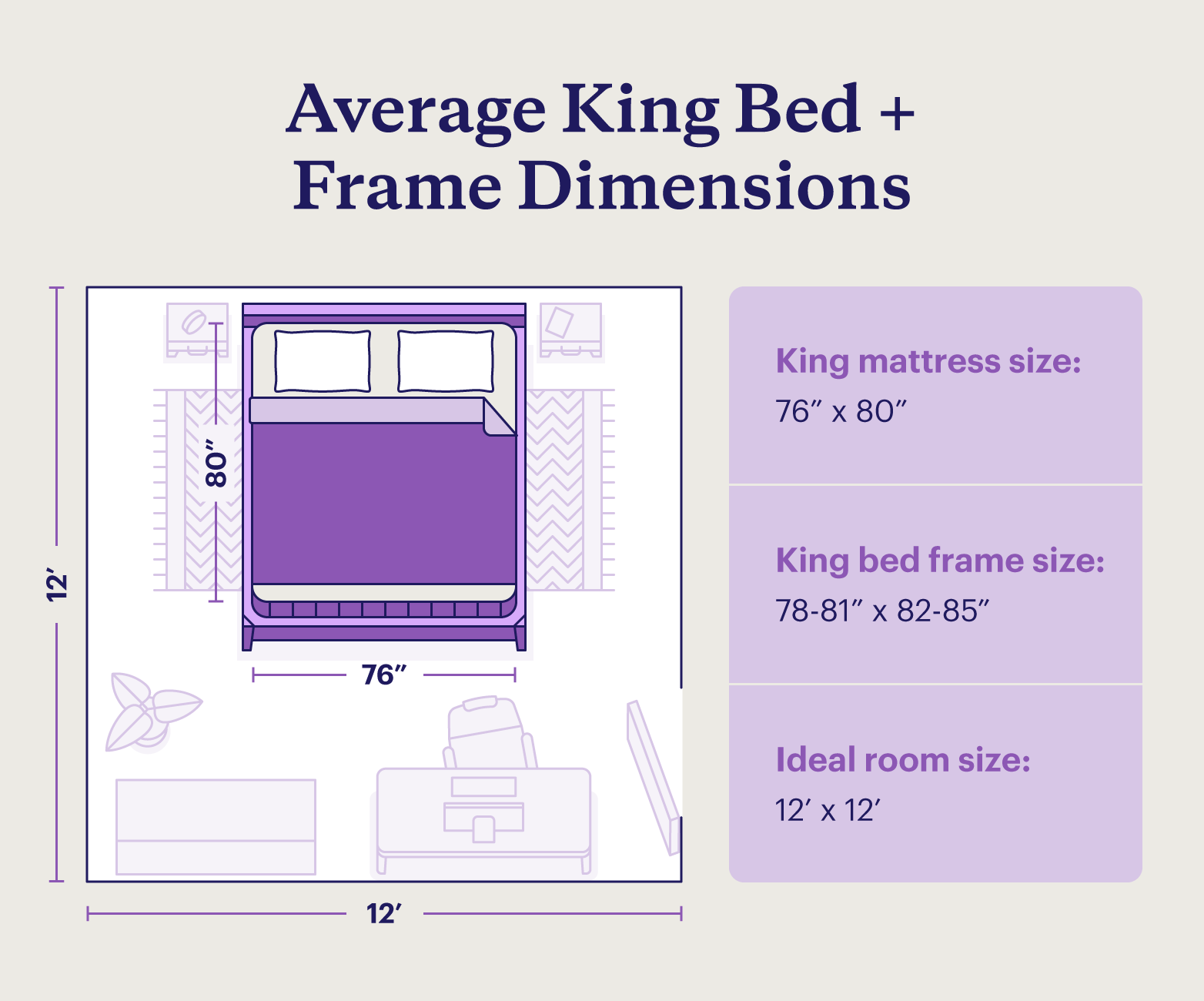
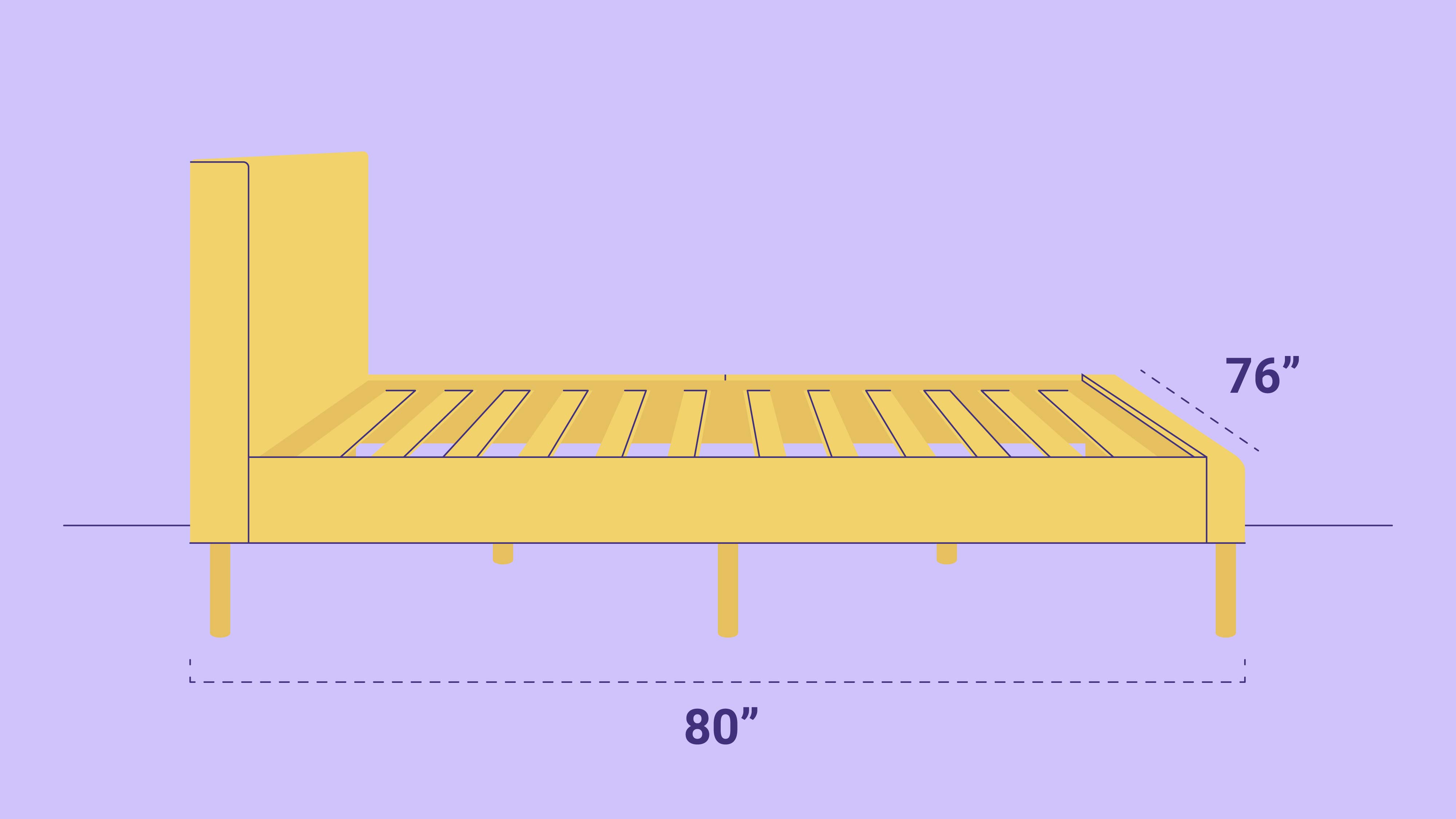
A standard US king mattress measures 76 inches wide by 80 inches long. Most king bed frames measure approximately 78 to 82 inches wide and 82 to 85 inches long, although the exact outside dimensions depend on the frame design.
When furnishing a bedroom in the United States, a king bed can take up more floor space than you might expect. The mattress alone measures 6 feet 4 inches wide and 6 feet 8 inches long. The bed frame adds more space, especially when it has thick side rails, a padded headboard, or a large footboard.
The difference between mattress size and frame size matters when planning a bedroom, choosing nightstands, or moving furniture through a doorway. A bed may fit the mattress you own but still take up too much room once the complete frame is in place.
This guide explains standard king bed frame dimensions, common frame sizes, room requirements, and simple ways to measure your space. It also compares standard king and California king beds so you can choose the correct size before buying.
What Are the Standard Dimensions of a King Bed Frame?
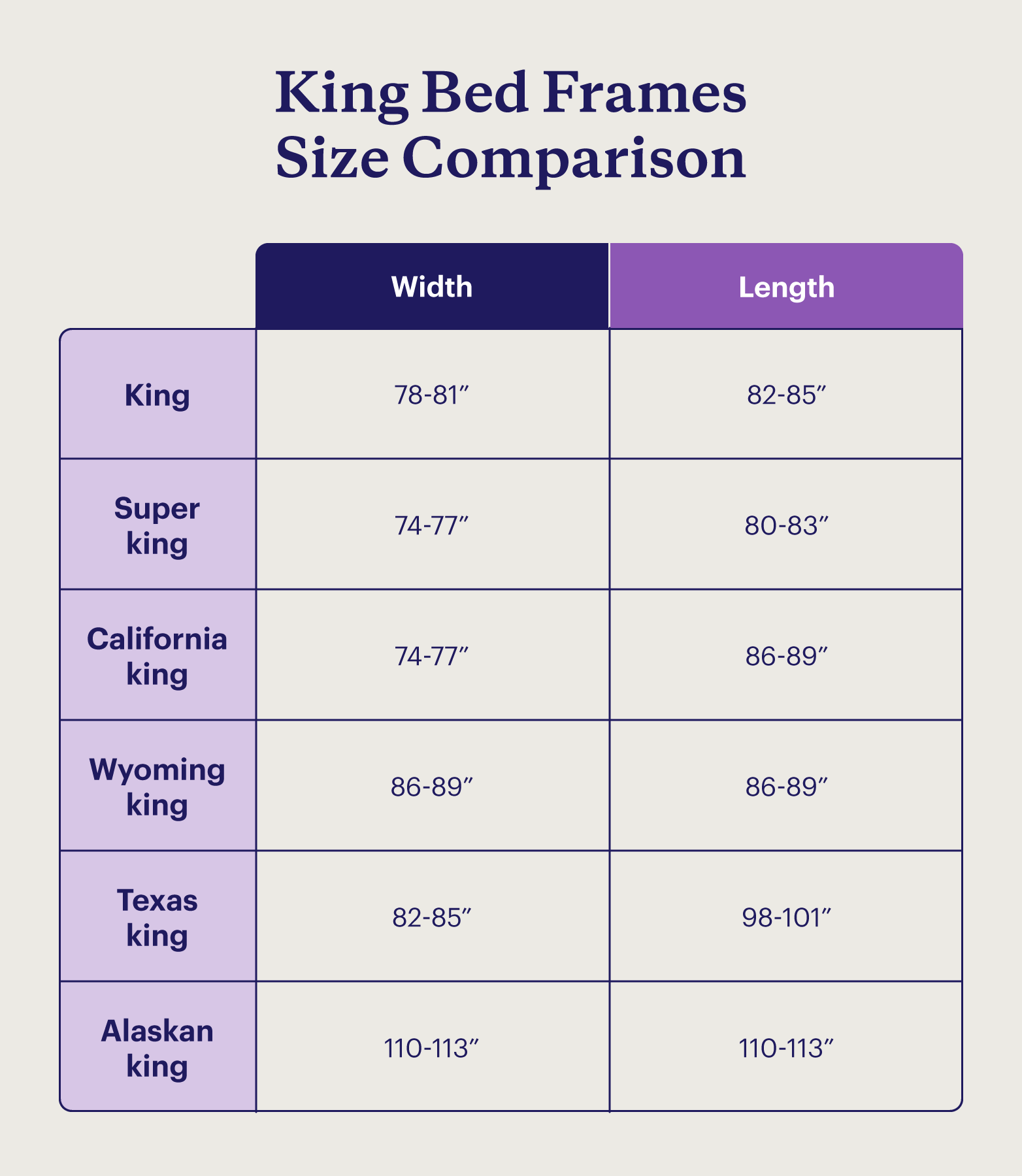
A standard king bed frame in the United States commonly measures about 78 to 82 inches wide and 82 to 85 inches long. These are useful planning estimates, not fixed industry dimensions for every frame.
The standard king mattress itself measures 76 inches wide by 80 inches long. The frame needs additional room for its side rails, support structure, headboard, and other parts. This is why the outside measurements are usually larger than the mattress measurements.
For example, a simple platform frame may add only a few inches to the mattress footprint. A large upholstered bed may extend much farther because of its padded sides and thick headboard.
The height also varies. Some frames sit close to the floor, while others have tall headboards, raised platforms, or built-in storage. Therefore, width, length, and height should all be checked before making a purchase.
Source: sleepjunkie.com
Standard king mattress width
76 inches, which is approximately 193 centimeters.
Standard king mattress length
80 inches, which is approximately 203 centimeters.
Typical frame width
Approximately 78 to 82 inches, depending on the frame construction.
Typical frame length
Approximately 82 to 85 inches, depending on the headboard and footboard.
Frame height
Varies by design, mattress support height, legs, and headboard style.
King Bed Frame Dimensions in Inches and Centimeters
Most American furniture measurements use inches, but centimeters can make room planning easier when comparing international furniture. The following chart separates the standard mattress footprint from a common frame planning range.
The frame measurements are estimates. Always replace them with the manufacturer’s published outside dimensions when measuring for a specific bed.
Mattress width
76 inches or approximately 193 centimeters.
Mattress length
80 inches or approximately 203 centimeters.
Estimated frame width
78 to 82 inches or approximately 198 to 208 centimeters.
Estimated frame length
82 to 85 inches or approximately 208 to 216 centimeters.
Why Is a King Bed Frame Larger Than Its Mattress?
A bed frame surrounds and supports the mattress. Its side rails, headboard, footboard, and connecting parts need extra space beyond the sleeping surface.
Think of the mattress as the inside area of a picture frame. The outside border takes up additional room, even though it does not increase the usable sleeping surface.
A wooden frame may have thick rails, while a metal frame may use slim support bars. An upholstered frame can have even more padding around the mattress. These construction differences explain why two king frames can have different outside dimensions.
Side rails
These run along both sides of the mattress and increase the total frame width.
Headboard
A thick or angled headboard can extend the total bed length.
Footboard
A decorative footboard can add extra length beyond the mattress.
Built-in storage
Storage drawers and surrounding panels can increase the frame footprint.
King Bed Frame Size Chart
A size chart makes it easier to understand how much floor space a king bed may need. The most important distinction is between the mattress dimensions and the complete frame dimensions.
The following table uses the standard US mattress size and approximate frame measurements for planning. Frame dimensions are not universal, so use them as a starting point rather than a product specification.
Source: purple.com
Standard mattress
76 inches wide by 80 inches long.
Estimated frame
78 to 82 inches wide by 82 to 85 inches long.
Approximate mattress area
6,080 square inches, or about 42.2 square feet.
Standard King Bed Measurements Compared
Here is a practical comparison of common king bed measurements. The mattress size is the standard US measurement, while the frame range is an estimate for basic planning.
King mattress
76 x 80 inches.
Basic king frame
Approximately 78 to 82 x 82 to 85 inches.
King mattress in feet
Approximately 6 feet 4 inches wide by 6 feet 8 inches long.
King mattress in centimeters
Approximately 193 x 203 centimeters.
How Much Floor Space Does a King Bed Occupy?
A standard king mattress covers about 42.2 square feet. A frame measuring 80 by 84 inches would cover approximately 46.7 square feet of floor space.
This example shows why using the mattress size alone can lead to a poor room layout. The additional frame space may affect the position of a dresser, nightstands, a closet door, or a walking path.
For accurate planning, calculate the area using the actual outside width and length of your chosen frame. Multiply the two measurements and divide by 144 to convert square inches into square feet.
Example calculation
80 inches multiplied by 84 inches equals 6,720 square inches.
Convert to square feet
6,720 divided by 144 equals approximately 46.7 square feet.
How Different King Bed Frame Styles Affect Dimensions
The style of a king bed frame can change its outside dimensions by several inches or more. A basic metal frame usually has a smaller footprint than a large upholstered bed with a thick headboard and footboard.
Before choosing a style, consider the room’s available floor space and the amount of storage or decoration you need. A larger frame may look attractive, but it can make a small bedroom feel crowded.
The following frame types explain which measurements deserve extra attention.
Source: storage.googleapis.com
Metal bed frames
Often have slim rails and a simple structure, which can keep the outside dimensions close to the mattress size.
Wooden bed frames
May have thicker side rails, decorative panels, and solid headboards that increase the footprint.
Upholstered bed frames
Padded sides and headboards can make the complete bed wider and longer.
Storage bed frames
Drawer systems and surrounding panels may require extra floor space and room for access.
Platform King Bed Frame Dimensions
A platform king bed frame supports a mattress on a built-in base, usually with slats or a solid support surface. It may not require a traditional box spring, but the exact requirement depends on the mattress and frame manufacturer.
A simple platform frame often has a relatively compact shape. However, models with wide side panels or a large headboard can extend beyond the common planning range.
Check the distance between support slats, the center support system, and the maximum mattress weight. These details matter because a frame must support the mattress and sleepers safely.
What to measure
Outside width, outside length, platform height, and the internal mattress support area.
What to verify
Mattress compatibility, center support, slat spacing, and weight limits.
Upholstered King Bed Frame Dimensions
Upholstered frames often have soft fabric or leather-like material over a padded structure. This padding can add several inches to the outside width and length.
A wingback headboard or a thick footboard can make the bed much larger than a simple platform frame. Some designs also have curved sides that take up more space than their basic mattress support area.
Measure the widest and longest points, not just the distance between the inside rails. If the headboard has wings, include them in your room layout.
Main measurement concern
Extra padding and decorative shapes may extend beyond the mattress footprint.
Room planning tip
Allow space for the widest part of the headboard and the full side profile.
Wooden and Sleigh King Bed Frames
Wooden king frames come in many shapes. A simple wooden platform may remain close to the mattress size, while a traditional sleigh bed can have large curved headboards and footboards.
Sleigh beds deserve special attention because their curved ends may extend farther than expected. Their shape can also affect how much room remains at the foot of the bed.
When measuring one of these beds, use its longest outside point. Do not rely only on the distance between the side rails.
Simple wooden frame
Usually has a straightforward rectangular footprint.
Sleigh bed
May need more length because of its curved headboard and footboard.
King Storage Bed Frame Dimensions
Storage beds use drawers, lift-up platforms, or built-in compartments to make better use of bedroom space. However, their storage features can change how much room the bed needs.
A drawer bed may fit against a wall in terms of its basic footprint, but the drawers need enough space to open. A lift-up storage bed may need clear space above the mattress when its platform is raised.
Check both the closed and open positions before deciding where to place the bed. This prevents a common problem in which the frame fits the room but the storage system cannot be used properly.
Drawer clearance
Measure the space needed to pull drawers fully open.
Lift-up clearance
Check the space needed to raise the mattress platform and access the storage compartment.
Access space
Make sure furniture and walls do not block the storage opening.
King Bed Frame Dimensions vs. King Mattress Dimensions
A king mattress and a king bed frame are not the same size. The mattress has a standard sleeping surface, but the frame has additional structural parts around it.
A standard US king mattress measures 76 by 80 inches. A frame may measure 80 by 84 inches, for example, because its rails and headboard take up additional room.
This difference is important when replacing an old bed frame or buying a new mattress. A frame designed for a standard king mattress should have an appropriate internal support area, even if its outside measurements vary.
Source: storage.googleapis.com
Mattress measurements
Describe the width and length of the sleeping surface.
Inside frame measurements
Describe the area where the mattress rests.
Outside frame measurements
Describe the complete floor footprint of the bed.
Can a King Mattress Fit on Any King Bed Frame?
Not necessarily. A frame labeled king should be designed for the standard king mattress, but not every bed frame uses the same construction or support system.
The mattress must fit inside the frame without excessive movement or unwanted pressure on its edges. A mattress that is too large may not sit correctly, while one that is too small may leave gaps.
Check the manufacturer’s mattress compatibility information. Also confirm whether the frame requires a box spring, foundation, or direct mattress support.
Check the mattress size
Confirm that your mattress is a standard US king measuring 76 by 80 inches.
Check the support area
Compare the mattress measurements with the frame’s inside dimensions.
Check the support system
Confirm the required foundation, slat spacing, and center support.
What Happens If the Frame Is Too Small or Too Large?
A frame that is too small may prevent the mattress from sitting flat. It can also place unwanted pressure on the mattress edges or interfere with its support.
A frame that is too large may leave visible gaps around the mattress. Depending on the design, the mattress may shift or fail to receive proper edge support.
Never force a mattress into a frame that does not match its intended size. Check the manufacturer’s specifications or ask the seller to confirm compatibility before assembly.
Frame too small
The mattress may not fit properly or rest evenly on the support structure.
Frame too large
The mattress may move or leave gaps around its edges.
Incorrect support
The frame may not provide the support required by the mattress manufacturer.
How Much Bedroom Space Do You Need for a King Bed Frame?
A bedroom around 12 by 12 feet is a useful starting point for planning a standard king bed. This gives you more room to add nightstands, storage furniture, and walking paths than a smaller bedroom would.
However, a 12-by-12-foot room is not a universal minimum. The best room size depends on the actual frame dimensions, door positions, closet access, windows, and the furniture you want to keep.
A king bed can sometimes fit in a smaller room, but the result may leave little space for movement. A larger room gives you more flexibility and makes it easier to arrange furniture without blocking doors or drawers.
Source: storage.googleapis.com
Room width
Consider the bed width, two side walking paths, and the width of both nightstands.
Room length
Allow for the bed length, space at the foot, and any furniture placed opposite the bed.
Door access
Check bedroom doors, closet doors, and bathroom entrances.
Furniture clearance
Make sure drawers, wardrobe doors, and other furniture can open.
Is a 10 by 12 Foot Bedroom Big Enough for a King Bed?
A 10-by-12-foot bedroom may fit a king bed, but the layout can be tight. A frame about 80 inches wide takes up 6 feet 8 inches of a 10-foot room, leaving only 40 inches of total width for both sides combined.
If the bed is centered, that leaves about 20 inches on each side before accounting for other furniture. This may be enough for basic access, but it can feel cramped when adding large nightstands.
The room’s 12-foot length also needs careful planning. A frame measuring 84 inches long leaves 60 inches of total space at the foot if the headboard rests against the wall, before considering other furniture.
For a smaller bedroom, choose a frame with slim rails and a simple headboard. Avoid bulky footboards and large storage units if they reduce the available walking space.
Best approach
Use a simple frame and measure all furniture before deciding on its position.
Potential problem
Large nightstands or dressers may make movement difficult.
Is a 12 by 12 Foot Bedroom Suitable for a King Bed?
A 12-by-12-foot bedroom is often more practical for a king bed than a 10-by-12-foot room. It gives you more flexibility to place nightstands and maintain walking space around the bed.
For example, an 80-inch-wide frame centered in a 144-inch-wide room leaves 64 inches of total side space. If divided evenly, each side has 32 inches before adding other furniture.
This is a useful layout for many households, although the position of windows, closets, and doors can still affect the final arrangement.
Better side access
The extra room allows more space beside the bed.
More furniture options
You may have room for nightstands and a dresser without blocking access.
How Much Walking Space Should You Leave Around the Bed?
A practical planning target is about 24 to 30 inches of open walking space beside the bed and at the foot. This is a furniture-layout guideline, not a universal building or accessibility requirement.
More space may be helpful if you use a wheelchair, walker, or other mobility aid. In that situation, plan around the actual equipment and any applicable accessibility requirements.
If the room is small, keep the walking paths clear and avoid placing furniture where it blocks the main route to the door.
24 inches
A compact planning allowance for basic movement.
30 inches
A more comfortable target for many bedroom layouts.
More clearance
May be needed for mobility equipment, larger furniture, or easier access.
King vs. California King Bed Frame Dimensions
A standard king and a California king are two different US mattress sizes. A standard king is wider, while a California king is longer.
A standard king mattress measures 76 by 80 inches. A California king mattress measures 72 by 84 inches. This means a California king is 4 inches narrower and 4 inches longer.
The same difference affects the frame. A California king frame must support the longer and narrower mattress, so a standard king frame is not automatically compatible with it.
Choose between these sizes based on your sleeping needs and bedroom shape. A standard king provides more width for two sleepers, while a California king provides additional length for taller sleepers.
Source: homedeso.vercel.app
Standard king mattress
76 inches wide by 80 inches long.
California king mattress
72 inches wide by 84 inches long.
Main difference
The standard king is wider, while the California king is longer.
Which Bed Is Better for Taller People?
A California king may suit taller sleepers because it provides 4 additional inches of mattress length. This can be helpful for people whose feet extend close to the edge of a standard king mattress.
However, mattress length is only one part of comfort. The sleeper’s preferred position, pillow thickness, and available room space also matter.
If two people want more side-to-side space, a standard king may be the better fit. It gives each sleeper approximately 38 inches of mattress width when two people share it.
Choose standard king
When extra width is the main priority.
Choose California king
When extra mattress length is more important.
Can You Use a Standard King Frame for a California King Mattress?
No, you should not assume that a standard king frame will fit a California king mattress. The two mattresses have different width and length measurements.
Using the wrong frame can create gaps, poor support, or an incorrect fit. Always choose a frame that specifically lists compatibility with your mattress size.
The same rule applies when buying a replacement headboard, foundation, or bed support system.
Verify the label
Look for a frame specifically marked California king.
Check the measurements
Confirm the inside support area matches the mattress.
How to Measure a King Bed Frame Correctly
Measuring a king bed frame before buying or arranging furniture is simple. You need a tape measure, a clear floor area, and the complete outside dimensions of the frame.
Do not measure only the mattress or the space between the side rails. The goal is to find the largest outside width and length, including decorative parts that extend beyond the main structure.
If the bed is already assembled, measure it in place. If you are shopping online, use the manufacturer’s specification sheet and compare it with your room measurements.
Tools
Use a tape measure, a pencil, and paper or a room-planning app.
Measurements
Record the maximum outside width, length, height, and mattress support area.
Room details
Measure doors, hallways, closets, and nearby furniture.
Step 1: Measure the Outside Width
Place the tape measure across the widest part of the frame from left to right. Include both side rails, decorative edges, and any parts that extend beyond the mattress.
If the headboard has wide wings, measure those separately because they may extend farther than the side rails.
Measurement to record
The maximum outside width of the complete frame.
Step 2: Measure the Outside Length
Measure from the farthest point of the headboard to the farthest point of the footboard. Include curved or padded sections that extend beyond the main structure.
For beds without a footboard, measure from the back of the headboard to the farthest point at the foot of the frame.
Measurement to record
The maximum outside length of the assembled frame.
Step 3: Measure the Frame Height
Measure from the floor to the top of the side rail or platform to determine the base height. Then measure the headboard separately from the floor to its highest point.
If you plan to use a thick mattress, calculate the final sleeping height by adding the mattress thickness to the support height. Include a foundation if the bed requires one.
Base height
The distance from the floor to the mattress support surface.
Headboard height
The distance from the floor to the highest point of the headboard.
Finished bed height
The base or foundation height plus mattress thickness.
Step 4: Measure Your Bedroom
Measure the room’s width and length. Mark the proposed bed location on paper and include the space needed for nightstands and other furniture.
Check whether doors can open fully and whether drawers can slide out without hitting the bed. Also consider the path from the bedroom entrance to the bed.
A cardboard outline or painter’s tape on the floor can help you see the bed’s footprint before moving heavy furniture.
Check the walls
Make sure the bed does not block windows, electrical outlets, or other useful features.
Check the doors
Allow room for bedroom, closet, and bathroom doors to open.
Check the furniture
Confirm that nightstands and dressers have enough space.
Step 5: Check Delivery and Assembly Access
A king bed may fit inside your bedroom but still be difficult to carry through the entrance. Large headboards, solid footboards, and assembled storage units can create delivery problems.
Measure the narrowest points along the delivery route, including exterior doors, interior doors, hallways, and staircases. Check whether the frame comes in separate pieces.
For tight spaces, ask the seller about package dimensions and assembly requirements before ordering.
Doorway width
Measure the usable opening rather than the full door frame.
Hallway clearance
Check narrow turns and corners along the delivery path.
Package dimensions
Compare the packed components with your available access space.
Common Mistakes When Choosing a King Bed Frame
Many bed frame problems start with small measurement mistakes. A few minutes of planning can help prevent an expensive return or a bedroom that feels too crowded.
The most common issue is assuming that every king frame has the same outside dimensions. Although the mattress size is standardized, frame construction varies widely.
Measuring only the mattress
The mattress does not include the extra space needed for side rails, headboards, or footboards.
Ignoring headboard depth
A thick or angled headboard may increase the total bed length.
Forgetting drawer clearance
Storage beds need extra room when their drawers are open.
Confusing king and California king
These sizes have different mattress dimensions and require compatible frames.
Ignoring delivery access
A frame may fit the room but not pass through a narrow doorway or hallway.
Overlooking support requirements
The frame must provide the correct support for the mattress and intended load.
How to Avoid Buying the Wrong Size
Start by identifying your mattress size. Then find the manufacturer’s published outside dimensions for the frame you plan to buy.
Compare those numbers with your room measurements and furniture layout. If a seller provides only the mattress compatibility size, request the complete assembled dimensions.
Keep a written record of the frame width, length, height, support measurements, and delivery package dimensions. This makes it easier to compare different designs without confusing their measurements.
Before ordering
Confirm the mattress type, frame dimensions, and room clearance.
Before delivery
Check the doorway, hallway, stairway, and package dimensions.
Before assembly
Read the instructions and verify all parts and support components.
Does a King Bed Frame Need a Box Spring?
Not every king bed frame needs a box spring. Many modern platform frames use slats or a solid support base that allows the mattress to rest directly on the frame.
Traditional metal bed frames may require a separate foundation or box spring. The correct setup depends on the frame design and the mattress manufacturer’s requirements.
Using the wrong support system can affect mattress performance and may create problems with warranty conditions. Check both sets of instructions before assembling the bed.
Platform frames
Often support a mattress directly through slats or a solid platform.
Traditional frames
May require a foundation or box spring.
Adjustable bases
Require a frame or setup specifically designed to accommodate the adjustable mechanism.
What Support Does a King Mattress Need?
A king mattress needs adequate support across its width and length. Many king frames include center support rails and additional legs to help distribute the weight.
The exact support design depends on the manufacturer’s specifications. Check the maximum load, center-leg requirements, and slat spacing before using the frame.
Do not remove support parts simply because the mattress appears stable. Missing components can increase stress on the frame and may cause sagging or damage.
Center support
Helps support the middle of a wide mattress.
Slats
Provide a surface that supports the mattress.
Support legs
Transfer weight from the frame toward the floor.
Research Notes and Important Measurement Limits
The standard 76-by-80-inch king mattress measurement is consistent across the US mattress size guides reviewed for this article, including published information from Casper, Sleep Foundation, and Costco.
Published frame guidance varies because the outside dimensions depend on the design. A basic frame and a large upholstered bed should not be expected to have identical measurements.
The approximate 78-to-82-inch width and 82-to-85-inch length range in this guide is a practical planning estimate. It is not a universal specification or a measurement of every king frame on the market.
The room-size examples are calculations based on stated frame dimensions. They are not the result of a physical room test. Likewise, the walking-space figures are planning suggestions rather than a substitute for applicable accessibility or building requirements.
Before making a purchase, use the manufacturer’s current product specification for the exact model. This is the most reliable way to confirm outside dimensions, mattress compatibility, support requirements, and assembly access.
Documented measurement
A standard US king mattress measures 76 by 80 inches.
Variable measurement
The outside dimensions of a king bed frame depend on its design and construction.
Calculated example
An 80-by-84-inch frame occupies approximately 46.7 square feet.
Not established
There is no single outside width, length, or height that applies to every king bed frame.
Frequently Asked Questions
Q
What are the exact dimensions of a standard king bed frame?
There is no single exact outside measurement for every standard king bed frame. A typical planning range is about 78 to 82 inches wide and 82 to 85 inches long. The standard king mattress inside the frame measures 76 by 80 inches. Always check the specific frame’s published measurements before buying.
Q
Is a king bed frame 76 by 80 inches?
The 76-by-80-inch measurement describes a standard US king mattress, not usually the complete outside dimensions of its frame. The frame needs extra space for its side rails, headboard, footboard, and support structure.
Q
How wide is a king bed frame in feet?
A typical king bed frame may measure about 6 feet 6 inches to 6 feet 10 inches wide. This estimate comes from a planning range of 78 to 82 inches. A large upholstered or decorative frame may be wider.
Q
How long is a king bed frame?
A typical king bed frame may measure approximately 82 to 85 inches long, or about 6 feet 10 inches to 7 feet 1 inch. The exact length depends on the headboard, footboard, and overall construction.
Q
Will a king bed fit in a 10 by 12 foot bedroom?
A king bed can fit in a 10-by-12-foot bedroom, but the layout may feel tight. An approximately 80-inch-wide frame leaves 40 inches of combined side space in a 120-inch-wide room. That is about 20 inches per side when centered, before adding nightstands. Measure the room and furniture carefully before choosing this setup.
Q
What is the recommended bedroom size for a king bed?
A 12-by-12-foot bedroom is a useful starting point for a standard king bed with some additional furniture. A larger room may be more comfortable if you want wide nightstands, a dresser, or extra walking space. The actual requirement depends on the frame and room layout.
Q
Are king and California king bed frames the same size?
No. A standard king mattress measures 76 by 80 inches, while a California king measures 72 by 84 inches. A California king is narrower and longer. The frames are designed for different mattress dimensions, so they should not be treated as interchangeable.
Q
Can two twin XL mattresses fit on a king bed frame?
Yes. Two standard Twin XL mattresses placed side by side have a combined size of 76 by 80 inches, which matches a standard US king mattress footprint. This setup is commonly called a split king. However, check that the frame supports the split configuration and that the mattresses remain properly aligned.
Q
How much bigger is a king frame than a king mattress?
The difference depends on the frame design. For example, a frame measuring 80 by 84 inches is 4 inches wider and 4 inches longer than a 76-by-80-inch mattress. This extra space comes from the frame rails, headboard, footboard, and other structural parts.
Q
Does a king bed frame include the headboard in its dimensions?
Not every product listing uses the same measurement method. Some manufacturers list the complete assembled dimensions, while others provide separate headboard and frame measurements. Check whether the listed length includes the headboard and footboard before planning your room.
Q
Can I use a queen bed frame for a king mattress?
No. A standard queen mattress measures 60 by 80 inches, while a king mattress measures 76 by 80 inches. A queen frame is not designed to support the wider king mattress. Choose a frame specifically made for a standard king mattress.
Q
How do I know if my existing bed frame is king size?
Measure the inside support area and check whether it is designed for a 76-by-80-inch mattress. Also inspect the manufacturer’s label or product information if available. Do not identify the size from the outside dimensions alone because different frame designs can have different widths and lengths.
✦ Wrapping Up
Conclusion
A standard US king mattress measures 76 inches wide by 80 inches long. A typical king bed frame may measure approximately 78 to 82 inches wide and 82 to 85 inches long, but the actual outside size depends on its design.
Metal, wooden, upholstered, platform, and storage frames can all have different measurements. Headboards, footboards, side rails, and storage features may add extra inches to the total footprint.
Before buying a frame, measure your mattress, bedroom, furniture, and delivery route. Leave enough room for walking, opening drawers, and accessing doors. If you are choosing between a standard king and California king, remember that the standard king is wider while the California king is longer.
The most reliable measurement is always the manufacturer’s published outside size for the exact frame you plan to purchase. A little planning now can save you from a difficult delivery, an uncomfortable layout, or the cost of returning the wrong bed.
💡 Key Takeaway
Measure your bedroom first, then look for a king bed frame that supports a 76-by-80-inch mattress. Confirm its complete outside width, length, height, center support, and delivery dimensions before placing your order.