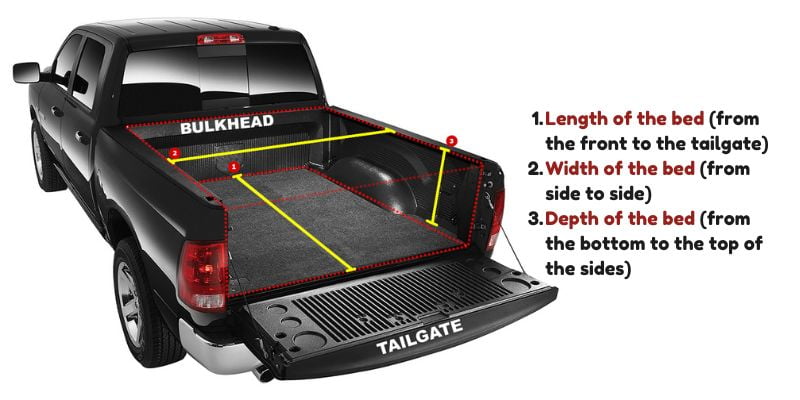
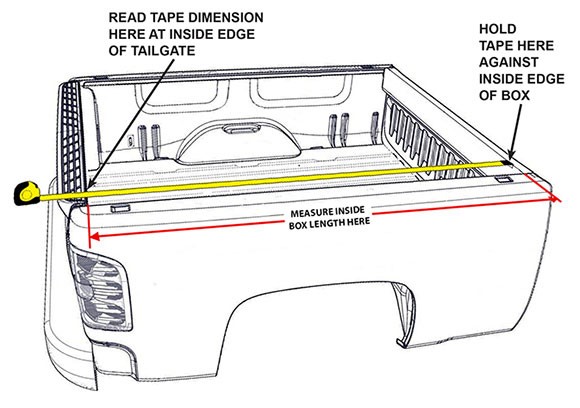
To measure a truck bed for a tonneau cover, use a tape measure to check the distance from the inside of the front bed wall (bulkhead) to the inside edge of the closed tailgate. Follow the cover manufacturer’s specified measuring points, record the result in inches, and confirm the fit using your truck’s year, make, model, and bed configuration.
If you own a Ford F-150, Chevrolet Silverado, GMC Sierra, Ram 1500, or Toyota Tacoma in the United States, measuring your truck bed is an important step before buying a tonneau cover. These pickups come with different bed lengths, and even trucks with the same name can have different configurations. A cover that fits one version may not fit another.
The good news is that you do not need special tools or automotive skills to measure your pickup bed. A standard tape measure, a clear view of the bed rails, and a few minutes are usually enough. The key is knowing where to start, where to stop, and which measurement your chosen cover manufacturer requires.
Truck makers often use rounded names such as 5.5-foot bed, 6.5-foot bed, and 8-foot bed. These names are useful for general identification, but they are not always the exact measurements of the usable bed. That small difference can affect the way a cover sits, seals, and latches.
This guide explains how to measure truck bed length, check the width and other important dimensions, identify common bed sizes, and avoid fitment mistakes. It also explains why measuring alone is not enough when your truck has a bed liner, factory cargo rails, a toolbox, or a special tailgate.
A tonneau cover is designed to fit a particular truck bed and mounting arrangement. If you choose the wrong size, the cover may sit unevenly, leave gaps, fail to latch, or interfere with the tailgate. Measuring before buying helps prevent these problems.
Many American pickup trucks offer several bed options. For example, a full-size pickup may have a short bed, a standard bed, or a long bed. The available lengths can also change with the cab style, model year, and trim package.
A truck bed measurement is more useful than a general size label because it gives you a physical reference. However, the measurement does not replace vehicle-specific fitment information. Two trucks can have similar interior lengths but different rail shapes, mounting points, and tailgate designs.
Think of measuring as the first part of a two-part check. The tape measure identifies the approximate bed size, while the manufacturer’s fitment guide confirms whether the actual cover works with your truck.
Source: tonneauguide.com
Prevent incorrect purchases
An accurate measurement helps you avoid ordering a cover intended for a shorter or longer bed.
Improve sealing
Correct fitment helps the cover’s seals meet the bed rails and tailgate as intended. No tonneau cover should be assumed to provide a completely waterproof seal.
Support proper installation
A compatible cover is more likely to line up with the correct mounting locations and allow the clamps and latches to work as designed.
Reduce returns and delays
Checking the truck details and measurements before ordering can prevent unnecessary exchanges and installation problems.
Why Truck Bed Names Can Be Confusing
A manufacturer may advertise a bed as 5.5 feet long, while a cover catalog may list the matching application as 5 feet 7 inches. These descriptions may refer to the same general bed configuration.
The difference comes from naming and measurement conventions. A published bed length may be rounded, while a measured dimension follows a particular reference point on the actual truck. This is why you should not reject a compatible cover simply because its advertised number differs slightly from your tape reading.
Nominal length
The rounded size used in vehicle brochures and product listings.
Measured length
The actual distance recorded between the specified points on your truck.
Compatible bed size
The exact bed configuration approved by the tonneau cover manufacturer.
Tools You Need Before Measuring a Truck Bed
You only need a few basic items to measure a pickup bed. A good tape measure is the most important tool because it lets you check the bed length and other dimensions without removing factory parts.
A metal retractable tape measure is a practical choice. Choose one long enough to span the entire bed, especially if you own a full-size pickup with an extended cargo box. A helper can make the process easier by holding the tape at the front wall while you read the measurement near the tailgate.
Before measuring, park your truck on level ground and make sure it cannot move. Remove loose cargo, tools, and anything that blocks access to the bed walls. You do not normally need to remove a permanently installed bed liner, but you should check whether it changes the mounting area or measurement points required by the cover instructions.
Source: YouTube > RealTruck.com
Tape measure
Use a reliable metal tape with clear inch markings. A tape of about 25 feet is generally convenient for pickup beds.
Notebook or phone
Record each measurement immediately so you do not confuse length, width, and depth.
Helper
Another person can hold the tape securely and reduce the chance of a crooked measurement.
Flashlight
Useful for checking the front wall, bed rails, clamps, and tailgate area.
Prepare the Truck Before Measuring
Start by parking on a flat surface and closing the tailgate. Make sure the truck is in Park or in gear, with the parking brake applied. Keep your hands clear of hinges and moving tailgate parts.
Clear the cargo area and inspect both bed rails. Look for plastic caps, utility tracks, factory tie-down systems, and other items that could affect how the cover mounts. If the truck has a removable accessory, do not remove it until you know whether the cover requires it to stay in place.
Take a moment to identify the truck’s year, make, model, cab style, and bed option. This information will be useful when checking the manufacturer’s compatibility chart.
Clear the bed
Remove loose objects that could move the tape or block the measuring points.
Inspect the tailgate
Check whether it is a standard tailgate or a special multi-function design.
Check the bed rails
Look for rail caps, tracks, racks, and mounting obstructions.
How to Measure a Truck Bed for a Tonneau Cover Step by Step
The main measurement is the distance between the front bulkhead and the inside edge of the closed tailgate. For many tonneau cover fitment guides, the measurement is taken along the top of the bed rail. Other instructions may specify a different reference line, so follow the exact method provided by the cover manufacturer.
Do not measure from the outside of the truck body or include the thickness of the tailgate. The goal is to identify the correct bed configuration, not to calculate the total length of the pickup from the cab to the bumper.
Source: onallcylinders.com
Step 1: Close the tailgate
Raise the tailgate and make sure it is fully closed and latched. This establishes the correct rear reference point for the measurement.
Step 2: Find the front bulkhead
Locate the inside wall at the front of the truck bed, directly behind the cab. This wall is also called the bed bulkhead.
Step 3: Position the tape
Place the tape measure at the inside face of the bulkhead at the reference height specified in the tonneau cover instructions. For a rail-based method, position it along the bed rail.
Step 4: Extend the tape toward the tailgate
Keep the tape straight and parallel to the bed side. Avoid diagonal measurements, bends, and loose sections.
Step 5: Read the measurement
Stop at the inside edge of the closed tailgate, following the manufacturer’s specified measuring point. Record the result in inches.
Step 6: Repeat the measurement
Measure the opposite side if the manufacturer’s instructions allow or recommend it. Compare both readings and investigate any noticeable difference.
Step 7: Confirm the truck configuration
Use your measurement along with the truck’s year, make, model, cab style, and bed configuration to check the cover fitment chart.
Where Exactly Should the Tape Measure Start?
The starting point is the inside face of the front bed wall, commonly called the bulkhead. This is the wall closest to the cab, not the back of the cab itself.
If your tonneau cover manufacturer specifies a measurement along the top of the bed rail, place the tape at the front bulkhead at that height. Keep the tape along the same rail line until you reach the inside edge of the closed tailgate.
Do not begin at the outside edge of a plastic bed cap or at the rear of the cab. These points can add unnecessary distance and produce a measurement that does not match the fitment chart.
Correct starting point
The inside face of the front bulkhead at the reference position specified by the manufacturer.
Incorrect starting point
The outside of the cab, the exterior body panel, or the front edge of a removable accessory.
Where Should the Measurement End?
The rear reference point is normally the inside edge or inside face of the closed tailgate, as defined by the manufacturer’s instructions. Do not include the entire tailgate or measure to the rear bumper.
The tailgate must be closed for this method because the cover is designed around the closed-bed opening. If the tailgate is down, the distance can change and may not represent the correct bed configuration.
Use the inside reference
Stop at the specified inside edge of the tailgate rather than its outermost surface.
Keep the tape straight
A straight measurement is easier to compare with manufacturer fitment information.
Should You Measure Along the Bed Rail or the Bed Floor?
This is an important point because different guides may show different measuring methods. RealTruck and etrailer describe measuring along the side of the bed from the inside bulkhead to the inside of the closed tailgate for tonneau cover sizing. Other products, including certain bed mats and liners, may require measurements along the floor.
For a tonneau cover, use the reference line in that cover’s own instructions. If the manufacturer asks for a rail measurement, do not substitute a floor measurement. If its instructions specify another reference point, follow that instead.
The top of the rail and the bed floor are not always the same length. A front bulkhead may slope, and the shape of the bed can affect the distance. Mixing these methods can create confusion when comparing your result with a published chart.
Rail measurement
Commonly used in tonneau cover measuring instructions. Follow the specified position along the top or inside of the bed rail.
Floor measurement
Useful for cargo space and products that specifically require floor dimensions. Do not assume it replaces a tonneau cover measurement.
Manufacturer instructions
The final authority for choosing the measurement method for a particular cover.
How to Measure Truck Bed Width and Depth
Length is usually the first measurement needed to identify a tonneau cover application. Width and depth can also help you understand the bed’s shape and identify possible installation problems.
Many custom tonneau covers are designed around a particular vehicle’s bed width, rail profile, and mounting points. As a result, the manufacturer may not ask you to enter a separate width measurement when ordering. Still, checking the available space can be useful if your truck has aftermarket accessories or unusual equipment.
Measure width and depth separately from length. Write down the locations where you take each measurement so you can compare them with the manufacturer’s instructions later.
Source: manuals.plus
Width
The distance across the inside of the bed from one side wall to the other.
Depth
The vertical distance from the bed floor to the top of the bed rail.
Wheel-well clearance
The narrowest distance between the wheel housings inside the bed. This is especially useful for checking cargo space and certain accessories.
How to Measure Truck Bed Width
Open the tailgate if necessary to reach the bed safely. Place the tape against the inside of one bed wall and extend it across to the inside of the opposite wall. Keep the tape level rather than allowing it to slope.
For a more useful record, measure near the front, around the middle, and near the tailgate. Some beds have slightly different widths at different positions. If you have a rail-mounted cover, note any factory tracks or accessories that reduce the available mounting space.
Do not confuse inside width with outside rail width. Outside width measures from one exterior rail edge to the other, while inside width measures the usable space between the bed walls. These dimensions serve different purposes.
Front width
Measure across the bed near the bulkhead.
Middle width
Measure across the center of the bed.
Rear width
Measure near the tailgate opening.
How to Measure Truck Bed Depth
To measure depth, place the tape at the bed floor near the side wall and extend it vertically to the top of the bed rail. Keep the tape upright rather than measuring at an angle.
If the floor has raised ribs, note whether you measure from the highest or lowest part. For a general record of the bed, the highest floor surface is a useful reference, but a product-specific instruction may require another point.
Depth is not normally the main measurement used to select a standard tonneau cover. It can still help identify unusual bed configurations and understand whether other accessories will interfere with the cover.
Use a vertical line
Keep the tape perpendicular to the bed floor.
Check both sides
Look for differences in bed liners, rail caps, or other installed equipment.
Common American Truck Bed Sizes and Measurement Examples
Most American pickup trucks fall into a few general bed-length categories. Short, standard, and long beds are common terms used by truck manufacturers and accessory sellers. However, the actual dimensions depend on the vehicle make, model, model year, and configuration.
The following table gives approximate reference ranges to help you understand common size labels. These are general examples, not a universal compatibility chart. A particular Ford, Chevrolet, GMC, Ram, or Toyota model may use a different advertised length or measurement convention.
Always compare your recorded measurement with the exact vehicle application in the tonneau cover manufacturer’s catalog. Do not order a cover based only on the table below.
Source: manuals.plus
Short bed
Often found in the general range of approximately 5 to 5.8 feet, depending on the truck.
Standard bed
Often around 6 to 6.7 feet on many full-size pickup configurations.
Long bed
Commonly around 8 feet on many full-size pickups.
Approximate Truck Bed Length Reference Table
Use this table to understand the relationship between feet, inches, and common truck bed descriptions. The listed values are nominal examples and should not be treated as exact dimensions for every truck.
5-foot bed
Approximately 60 inches. Often associated with compact and midsize pickup configurations.
5.5-foot bed
Approximately 66 inches. Common as a short-bed description on some full-size pickups.
5.7-foot bed
Approximately 68.4 inches. Used as a nominal description in some pickup applications.
6-foot bed
Approximately 72 inches. Available on some midsize pickups.
6.5-foot bed
Approximately 78 inches. A common standard-bed description on several full-size trucks.
8-foot bed
Approximately 96 inches. Commonly associated with long-bed pickup configurations.
Example: Measuring a Ford F-150 Bed
A Ford F-150 may be available with different box configurations, depending on the model year and cab style. A buyer may see a short box listed around 5.5 feet, a standard box around 6.5 feet, and a long box around 8 feet.
Suppose your tape reads approximately 67 inches using the tonneau cover manufacturer’s specified reference points. That result may correspond to a bed advertised as 5 feet 7 inches rather than exactly 5 feet 6 inches.
This does not automatically mean the measurement is wrong. Compare the result with the correct F-150 model year and bed option in the cover manufacturer’s fitment chart.
Record the result
Write down the exact reading, such as 67 inches.
Identify the vehicle
Record the F-150 model year, cab style, and bed configuration.
Verify compatibility
Check the cover listing for the exact vehicle application before purchasing.
Example: Measuring a Chevrolet Silverado 1500 Bed
The Chevrolet Silverado 1500 also comes with different bed options. Depending on the generation and configuration, you may find short, standard, and long box descriptions.
For example, a buyer who records a measurement near 79 inches should not assume that every cover listed for a 6.5-foot bed will fit. The Silverado’s model year, bed style, rail design, and tailgate configuration still matter.
Use the exact measurement as a cross-check, then confirm the correct Silverado application in the manufacturer’s catalog.
Check the model year
Bed dimensions and mounting systems can change between generations.
Check the box style
Make sure the cover is listed for the same bed configuration.
Check factory equipment
Look for special cargo management systems and tailgate features.
How to Convert Truck Bed Measurements From Inches to Feet
Truck bed measurements are often recorded in inches, while product listings may describe them in feet. Converting between the two units is simple because one foot equals 12 inches.
Divide the number of inches by 12 to find the measurement in feet. You can also divide the measurement into whole feet and remaining inches, which is often easier to compare with truck bed labels.
Keep the original inch measurement in your notes. The converted value is useful for understanding the bed size, but the exact number is more helpful when checking fitment.
Source: sharptruck.com
Example 1: 66 inches
66 divided by 12 equals 5.5 feet, or 5 feet 6 inches.
Example 2: 78 inches
78 divided by 12 equals 6.5 feet, or 6 feet 6 inches.
Example 3: 96 inches
96 divided by 12 equals 8 feet, or 8 feet 0 inches.
Example 4: 67 inches
67 inches equals 5 feet 7 inches, or approximately 5.58 feet.
Simple Measurement Conversion Formula
Use this basic formula whenever you need to convert an inch measurement into feet:
Formula
Length in feet = Length in inches divided by 12.
Worked example
A 77-inch measurement divided by 12 equals 6 feet with 5 inches remaining.
Shopping tip
Keep both the original inch reading and the feet-and-inches version when comparing product listings.
How Bed Liners and Accessories Affect Tonneau Cover Fit
A truck’s bed accessories can affect tonneau cover compatibility even when the bed length is correct. Some accessories change the available mounting space, while others interfere with the cover’s rails, clamps, or seals.
Before buying a cover, inspect the entire bed rather than checking only its length. A drop-in bed liner, factory cargo track, toolbox, bed rack, or special tailgate may require a different cover design.
Do not assume that an accessory must always be removed. Some manufacturers offer covers designed to work with specific factory systems and bed equipment. The important step is to verify that the exact combination is supported.
Source: storage.googleapis.com
Drop-in bed liners
A thick plastic liner may cover the bed rail or change the available clamp area. Check whether the cover requires liner trimming or a special installation method.
Spray-in bed liners
These coatings usually follow the bed’s shape, but the coating and rail finish should still be checked against the mounting instructions.
Factory cargo tracks
Utility tracks and adjustable tie-down systems may need specific brackets or a compatible cover design.
Toolboxes
A toolbox near the cab can occupy space needed by a standard cover. A toolbox-compatible or low-profile design may be required.
Bed racks
A ladder rack, sports bar, or other rack can interfere with the cover’s opening and mounting system.
Special tailgates
Multi-function tailgates may require a cover specifically approved for that tailgate design.
Can You Measure a Truck Bed With a Bed Liner Installed?
Yes, you can take a preliminary measurement with a bed liner installed. However, you need to know whether the liner covers the measuring points or changes the space available for mounting the cover.
A drop-in liner may have raised edges that sit over the bed rails. This can change where a cover rests or where its clamps attach. Some covers work with these liners, while others require a compatible liner design or specific installation changes.
Check the cover instructions before removing or cutting any liner. Removing material without confirming the requirements could damage the liner or affect the truck’s finish.
Identify the liner type
Determine whether the truck has a drop-in plastic liner, spray-in coating, or separate bed mat.
Inspect the rail area
Look for material that covers the intended mounting surface.
Check the installation guide
Confirm whether the cover supports your liner and whether any changes are required.
What If Your Truck Has a Toolbox?
A crossover toolbox mounted near the cab can prevent a standard tonneau cover from closing properly. It may also block the front mounting area or occupy the space where a folding or retractable cover needs to sit.
Measure the toolbox’s position and size, but do not treat these measurements as proof of compatibility. Look for a cover specifically designed for toolbox installations or a model whose manufacturer confirms that it works with your existing setup.
Check toolbox placement
Identify how far the box extends into the bed and whether it sits above or below the bed rails.
Check cover clearance
Confirm that the cover can close without touching the toolbox.
Confirm the mounting design
Check whether the cover needs special brackets or a toolbox-specific version.
How to Choose the Correct Tonneau Cover After Measuring
Once you have measured your truck bed, the next step is to compare the result with a vehicle-specific fitment guide. Do not choose a cover based only on a matching number in the product title.
Enter the truck’s year, make, model, cab style, and bed length into the manufacturer’s vehicle selector whenever one is available. Read the complete compatibility information, especially if your truck has factory cargo rails, a toolbox, a bed liner, or a special tailgate.
The cover style is another important decision. Soft roll-up, soft folding, hard folding, and retractable covers use different structures and mounting arrangements. Their installation needs may vary even when they are made for the same truck bed.
Source: tonneauguide.com
Soft roll-up covers
These covers roll toward the cab and are generally lightweight. Check the rail mounting system and the amount of bed access available when open.
Soft folding covers
These use flexible or framed sections that fold toward the cab. Verify the folded position and the required clearance.
Hard folding covers
These use rigid panels and may require particular rail and tailgate clearances. Check how the panels stack when opened.
Retractable covers
These slide toward a storage canister near the cab. Confirm that the canister has enough space and does not conflict with a toolbox or other equipment.
One-piece covers
These lift as a single rigid panel. Check the hinge, support, and mounting requirements before purchasing.
Use Your Truck’s Full Vehicle Information
A reliable product search begins with more than the truck’s brand. The same pickup model can have different bed dimensions and mounting features across model years and trims.
For example, a 2020 Ford F-150 and a 2024 Ford F-150 may look similar, but that does not establish that every tonneau cover fits both. Changes in bed design, factory equipment, or accessories can affect compatibility.
Use the vehicle identification details requested by the cover manufacturer. If the fitment chart asks for a specific bed option, select that option instead of guessing from the truck’s overall appearance.
Year
Record the exact model year.
Make and model
Identify the truck, such as Chevrolet Silverado 1500 or Toyota Tacoma.
Cab style
Record the correct cab configuration.
Bed configuration
Identify the short, standard, or long bed option.
Factory equipment
List any cargo systems, special tailgate, or other features that may affect fit.
Read the Manufacturer’s Fitment Notes
A product page may list several compatible vehicles, but the small fitment notes can contain important conditions. Look for restrictions involving factory bed rails, plastic rail caps, bed liners, tailgate designs, and mounting hardware.
Also check whether the cover requires drilling, trimming, or removal of an existing accessory. If the instructions are unclear, contact the manufacturer with your exact truck information and recorded dimensions before ordering.
Confirm the bed option
Make sure the listing identifies your actual bed length.
Review installation requirements
Check clamp positions, rail clearance, and any special mounting instructions.
Check the return policy
Understand the seller’s rules before opening or installing the cover.
Common Truck Bed Measuring Mistakes to Avoid
Even a simple measurement can go wrong when you use the wrong reference points. The most common problems involve measuring the outside of the truck, leaving the tailgate open, using the wrong line, or assuming a rounded size label is exact.
Take your time and repeat the process if the result looks unusual. A second measurement is much easier than dealing with an incompatible cover after delivery.
Source: YouTube > RealTruck.com
Measuring with the tailgate open
An open tailgate changes the measuring reference and may produce an incorrect result. Close and latch it when using the standard closed-tailgate method.
Measuring the exterior body
The outside length of the pickup is not the usable bed length. Measure between the specified inside reference points.
Starting at the cab
The rear of the cab is not the front bulkhead reference point. Begin at the inside face of the bed’s front wall.
Including the tailgate thickness
Do not add the full thickness of the tailgate to the bed measurement.
Measuring diagonally
A diagonal tape line produces a longer reading than a straight measurement. Keep the tape parallel to the bed side.
Using only the floor measurement
Some tonneau cover instructions specify a rail measurement. Follow the correct reference line rather than using another product’s method.
Ignoring accessories
Cargo tracks, toolboxes, and bed racks can affect compatibility even when the length is correct.
Rounding too early
Write down the exact inch measurement first. Use the manufacturer’s size category only after comparing the result with its fitment chart.
What If Your Two Measurements Are Different?
If the left and right measurements differ, repeat both readings and make sure the tape is straight. Check that you used the same starting and ending points on each side.
A small difference may come from measurement technique, bed shape, or the position of rail caps and other equipment. A larger or unexplained difference should not be ignored, especially when buying a rigid cover.
Record both measurements and contact the cover manufacturer if the difference could affect installation. Do not simply choose the larger or smaller number without checking the specified fitting method.
Check tape position
Make sure both readings follow the same reference line.
Check the tailgate
Confirm that the tailgate is fully closed and latched.
Inspect the rails
Look for damage, uneven caps, or aftermarket equipment.
What If Your Measurement Does Not Match a Listed Bed Size?
Do not assume that your truck is unusual or that the measurement is wrong. Manufacturers and accessory brands may use different naming conventions and reference points.
Keep the exact measurement and search by the full truck details. If the product listing shows a slightly different nominal length, ask the manufacturer whether that specific cover is designed for your vehicle.
Repeat the measurement
Check the starting point, ending point, and tape alignment.
Check the model year
Make sure the vehicle details are correct.
Ask for confirmation
Send the manufacturer your exact measurement and truck configuration.
How to Check Whether a Tonneau Cover Fits After Installation
After installing the cover, inspect its position before driving. A correctly selected cover should sit in the intended mounting area, close according to its instructions, and allow its latches to engage without forcing the panels or rails.
Check the seals around the front, sides, and tailgate. The exact contact points depend on the cover design, so use the installation guide rather than expecting every model to have the same seal arrangement.
If something does not line up, stop and inspect the installation. Do not force a latch or tighten a clamp beyond the specified limit to make an incompatible cover fit.
Source: manuals.plus
Check the side rails
Make sure the cover rails sit in the correct position and remain aligned with the bed.
Check the front seal
Confirm that the front section contacts the intended sealing surface.
Check the tailgate area
Make sure the rear edge and tailgate seals meet as described in the installation instructions.
Check the latches
Verify that the latches engage and release smoothly.
Check panel movement
For folding or retractable designs, confirm that the cover moves without binding or striking other equipment.
Signs That the Cover May Be the Wrong Size
A cover that is too short may leave an exposed gap near the tailgate or fail to reach the correct mounting area. A cover that is too long may overlap the intended surface or prevent proper closure.
A cover that appears to fit but does not latch correctly may have an installation problem, an incorrect mounting position, or a compatibility issue. Do not assume that adjusting the clamps will solve every problem.
Check the part number against the vehicle fitment information. If the cover is not approved for your exact truck configuration, contact the seller before modifying any component.
Visible gaps
The cover does not reach the intended sealing area.
Uneven alignment
One side sits differently from the other or the panels do not follow the bed rails.
Latch problems
The rear latches cannot engage normally.
Binding
The cover catches on the bed rails, toolbox, tailgate, or another accessory.
How to Check for Water Leaks
A tonneau cover can help shield cargo from rain and road spray, but many models are water-resistant rather than completely waterproof. Small amounts of moisture may enter through normal drainage paths or gaps around the tailgate.
If you notice water inside the bed, inspect the seals and drainage tubes if your model has them. Make sure the tubes are correctly routed and are not blocked or pinched.
Follow the manufacturer’s maintenance instructions. Do not add sealant or make permanent changes unless the manufacturer approves them.
Inspect the perimeter seals
Look for rolled, damaged, dirty, or misplaced seals.
Check drainage paths
Make sure the cover’s designed water channels and drain tubes are clear.
Inspect tailgate contact
Check the rear seal and the tailgate’s alignment.
A Practical Measurement Checklist Before Ordering
Before purchasing a tonneau cover, organize your measurements and vehicle information in one place. This makes it easier to compare product listings and ask the manufacturer clear questions.
A simple checklist can also help when you are buying a used cover. A used cover should not be purchased just because its seller says it came from a similar truck. Verify its original part number and compare its approved applications with your vehicle.
If any information is missing, contact the seller or manufacturer before paying. This is especially important for covers with model-specific rails, brackets, or hardware.
Source: manuals.plus
Truck year
Write down the exact model year.
Truck make and model
Record the full vehicle name and series.
Cab configuration
Identify the cab style shown in the vehicle specifications.
Bed configuration
Record the advertised bed option and the measured length.
Measurement method
Write down whether you used the rail, floor, or another manufacturer-specified reference.
Width and depth
Keep additional measurements if the product instructions or accessories require them.
Bed accessories
List liners, toolboxes, factory tracks, racks, and special tailgates.
Cover part number
Confirm the exact model and hardware kit before purchasing.
What Information Should You Give a Tonneau Cover Seller?
If you cannot identify the correct cover, provide the seller with the truck’s year, make, model, cab style, bed configuration, and exact measurement. Include clear photographs of the bed rails, front bulkhead, and tailgate if the seller requests them.
Mention any factory cargo system, toolbox, bed liner, or aftermarket rack. These details can help the seller determine whether a standard cover or a special version is required.
Ask for confirmation of the exact part number rather than relying on a general statement that the cover fits your truck brand.
Provide exact vehicle details
Avoid vague descriptions such as a regular-size pickup.
Share your measurements
Include the exact inch readings and measuring reference.
Describe modifications
List all accessories that could affect mounting and clearance.
Research Notes and Next-Question Gap Map
The main reader task is identifying the correct pickup bed configuration before buying a tonneau cover. The article focuses on U.S. pickup owners who need a practical measurement method, a way to understand advertised bed sizes, and a reliable fitment check.
The reviewed guidance included etrailer’s truck bed measurement instructions, RealTruck’s measurement and vehicle-size guidance, and a recent truck accessory retailer guide from Truck Covers MN. The reviewed pages generally explain the main length measurement, but their explanations vary in how they describe the reference line and the role of additional dimensions.
The most useful clarification is to separate the measurement method from the final compatibility decision. A rail measurement may be specified for one tonneau cover application, while another product may require a different reference. A measurement alone cannot establish compatibility with every truck and every cover.
The next-question map below distinguishes practical follow-up needs inferred from the main task from questions that were directly covered in the inspected material. It does not claim verified search demand or represent a complete survey of all available pages.
Source: sharptruck.com
How do I measure a truck bed with a bed liner?
Reader stage: Before ordering. Basis: Inferred next need from the possibility that liners change the mounting area. Reviewed coverage: Partly answered. Priority: High. Placement: Bed accessories section.
Should I measure along the bed rail or floor?
Reader stage: During measuring. Basis: Guidance comparison across reviewed pages. Reviewed coverage: Different methods are described for different products. Priority: High. Placement: Step-by-step measuring section.
What if my tape measurement does not match the advertised bed size?
Reader stage: Before ordering. Basis: Inferred next need from differences in nominal and measured lengths. Reviewed coverage: Partly answered. Priority: High. Placement: Measurement examples and troubleshooting.
Can a tonneau cover fit with a toolbox?
Reader stage: Compatibility check. Basis: The issue is explicitly discussed in reviewed fitment guidance. Reviewed coverage: Answered at a general level. Priority: High. Placement: Accessories section.
How do I check whether an installed cover fits correctly?
Reader stage: After purchase. Basis: Inferred next need from the measuring and installation task. Reviewed coverage: Not fully covered by the core measurement pages. Priority: Medium. Placement: Post-installation section.
Frequently Asked Questions
Q
How do I measure my truck bed for a tonneau cover?
Close the tailgate and locate the inside face of the front bulkhead. Use a tape measure to measure toward the inside edge of the closed tailgate, following the reference line specified by the tonneau cover manufacturer. Record the result in inches and compare it with the correct vehicle fitment chart.
Also record your truck’s year, make, model, cab style, and bed configuration. These details help identify the correct cover.
Q
Do I measure a truck bed with the tailgate open or closed?
For the common bulkhead-to-tailgate measurement, close and latch the tailgate. The measurement ends at the inside edge of the closed tailgate, not at the rear bumper or the end of an open tailgate.
If a particular manufacturer’s instructions specify a different setup, follow those instructions.
Q
Should I measure the inside or outside of my truck bed?
Use the inside reference points specified by the tonneau cover manufacturer. A common method measures from the inside of the front bulkhead to the inside edge of the closed tailgate along the bed rail.
Do not use the truck’s exterior body length as a substitute. Outside rail width and inside bed width are also different measurements.
Q
Can I use my truck’s advertised bed size instead of measuring it?
The advertised bed size is useful for identifying the general configuration, but it may be rounded. The actual measurement can differ slightly from the product’s nominal size description.
Use the advertised size together with your tape measurement and vehicle information. The manufacturer’s fitment chart should determine the final compatible cover.
Q
What is the most common truck bed length?
There is no single bed length used by every American pickup. Many full-size trucks offer short beds around 5.5 feet, standard beds around 6.5 feet, and long beds around 8 feet.
Midsize pickups may have shorter configurations. Always check the exact model year and bed option rather than assuming that every truck uses the same dimensions.
Q
Can two different truck brands use the same tonneau cover size?
Two trucks may have similar measured bed lengths, but that does not mean they can use the same tonneau cover. Rail profiles, mounting locations, bed shapes, and tailgate designs may differ.
A cover must be approved for the specific truck application. Similar length measurements alone are not enough to establish compatibility.
Q
How accurate should my truck bed measurement be?
Record the measurement as accurately as your tape allows, preferably to the nearest fraction of an inch when practical. Do not round the number before checking the fitment chart.
The manufacturer may use a nominal size that differs slightly from your reading. This is not necessarily a problem, provided the exact truck application is approved.
Q
Do I need to measure truck bed width for a tonneau cover?
For many vehicle-specific tonneau covers, the manufacturer uses your truck’s year, make, model, and bed option to determine the correct width and mounting system. You may not need to enter a separate width measurement.
However, measuring the width can be useful if your truck has unusual rail equipment, aftermarket accessories, or a modified bed. Follow the cover manufacturer’s requirements.
Q
Will a tonneau cover fit if my truck has a spray-in bed liner?
Many tonneau covers can work with spray-in bed liners, but compatibility depends on the cover’s mounting design and the condition of the rail surfaces.
Check the installation instructions to confirm that the liner does not interfere with the clamps, brackets, or seals. Do not assume that every liner and cover combination is supported.
Q
Can I install a tonneau cover myself after measuring?
Many tonneau covers are designed for owner installation with basic hand tools. However, the steps vary by cover type and truck configuration.
Read the complete installation guide, use the supplied hardware, and follow the specified clamp positions and tightening instructions. If the installation requires modifications you are not comfortable performing, use a qualified installer.
✦ Wrapping Up
Conclusion
Measuring a truck bed for a tonneau cover is a simple task when you know the correct starting and ending points. Begin at the inside of the front bulkhead and measure toward the inside edge of the closed tailgate, following the reference line specified by the cover manufacturer. Record the exact measurement in inches and repeat it to check your result.
Remember that the advertised bed length is not always the exact tape measurement. A short bed, standard bed, and long bed can have different dimensions depending on the truck’s make, model, year, and configuration. Bed liners, factory cargo tracks, toolboxes, and special tailgates can also affect compatibility.
The most reliable approach is to combine accurate measurements with complete vehicle information. Check the manufacturer’s fitment chart, confirm the exact cover part number, and read the installation requirements before purchasing. These simple checks can help you avoid an incorrect order and enjoy a better-fitting tonneau cover.
💡 Key Takeaway
Before ordering, close your tailgate, measure from the inside of the front bulkhead to the specified inside tailgate reference point, and record the result in inches. Then verify your truck’s year, make, model, cab style, bed configuration, and accessories against the tonneau cover manufacturer’s official fitment guide.