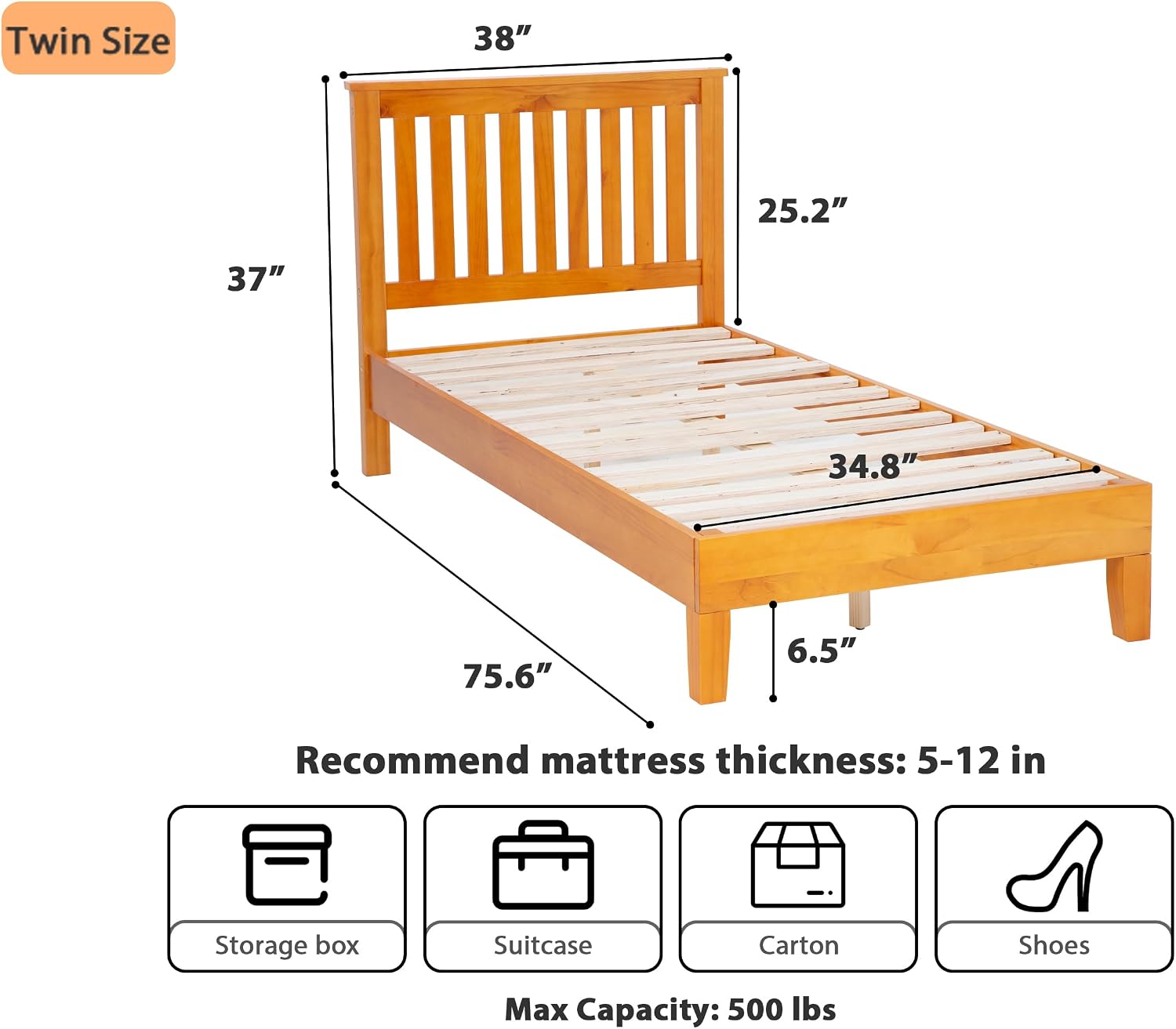
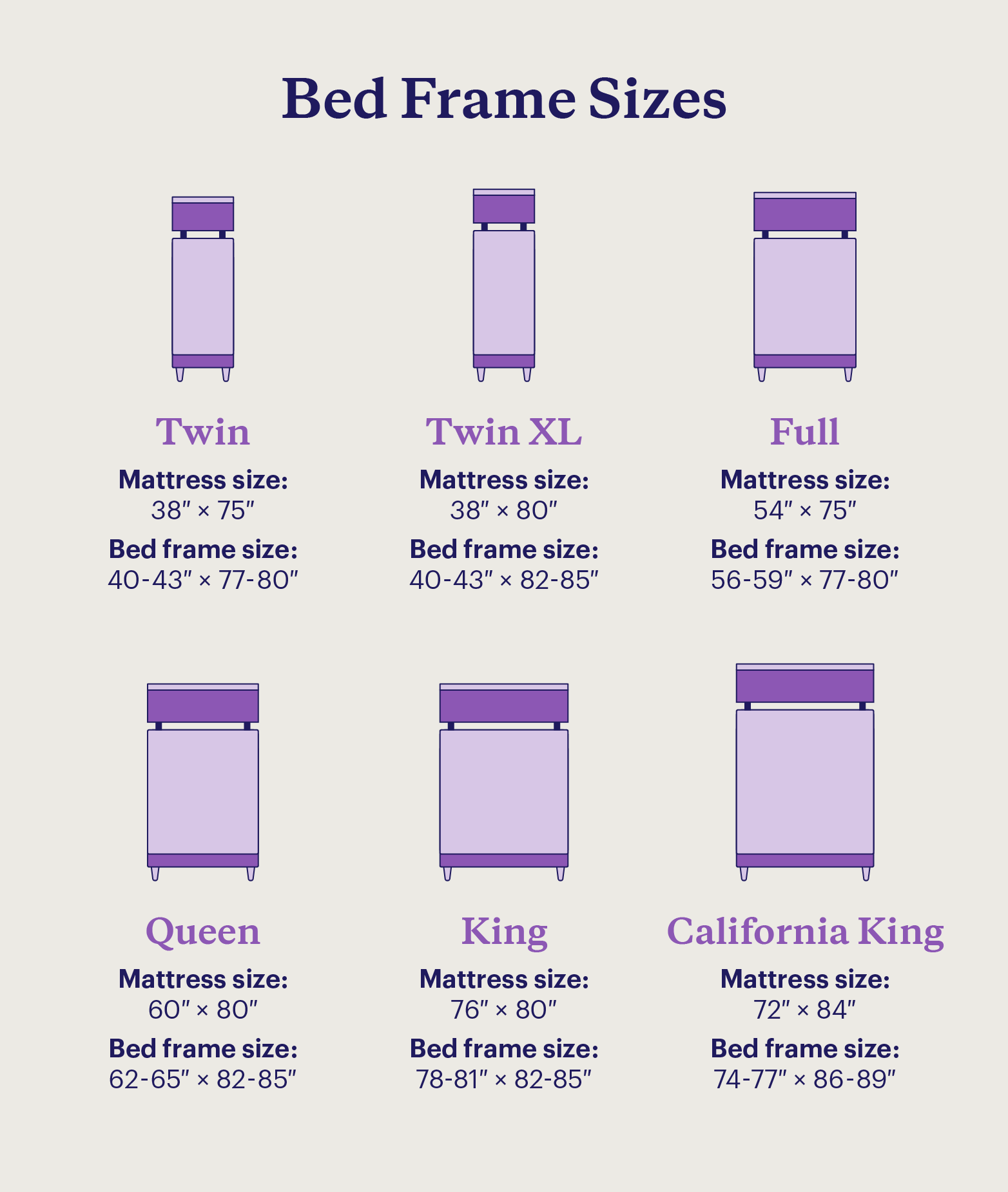
A standard twin mattress measures 38 inches wide by 75 inches long. A twin bed frame usually measures about 38 to 43 inches wide and 75 to 80 inches long, depending on its design.
When shopping for a bed frame in the United States, knowing the correct size can save you time, money, and the trouble of returning furniture. A standard twin bed is a common choice for children’s bedrooms, college dorms, guest rooms, and small apartments. Its compact size leaves more floor space for desks, dressers, and other furniture.
However, the mattress size and the complete bed frame size are not always the same. A twin mattress usually measures 38 by 75 inches, while the frame may extend several inches beyond those measurements because of its side rails, headboard, footboard, and other parts. The exact outside size depends on the frame style and manufacturer.
Before buying a frame, I recommend checking both the inside measurements and the outside measurements. The inside space must support the mattress correctly, while the outside dimensions tell you how much floor space the bed will use. This simple check helps prevent problems with tight corners, doors, walls, and nearby furniture.
What Are the Standard Dimensions of a Twin Bed Frame?
A standard twin bed frame is designed to hold a mattress measuring approximately 38 inches wide and 75 inches long. In metric measurements, this equals about 96.5 centimeters wide and 190.5 centimeters long. These are the standard mattress dimensions commonly used in the United States.
The complete frame is often slightly wider and longer than the mattress. This extra space comes from the side rails, frame construction, headboard, footboard, and decorative features. Many basic twin frames measure around 38 to 43 inches wide and 75 to 80 inches long on the outside.
There is no single outside measurement that applies to every twin bed frame. A simple metal platform frame may stay close to the mattress footprint, while a large upholstered frame can add several inches to each side. Always use the manufacturer’s product specifications for the exact model.
Source: storage.googleapis.com
Standard mattress width
38 inches, or approximately 96.5 centimeters.
Standard mattress length
75 inches, or approximately 190.5 centimeters.
Common frame width
Approximately 38 to 43 inches for many basic and moderately sized designs.
Common frame length
Approximately 75 to 80 inches, depending on the headboard and footboard design.
Typical sleeping capacity
One person, since the mattress provides about 38 inches of sleeping width.
Mattress Dimensions Versus Frame Dimensions
The mattress dimensions describe the sleeping surface. Frame dimensions describe the furniture that supports and surrounds that mattress. These measurements serve different purposes, so they should not be treated as interchangeable.
For example, a twin mattress may measure 38 by 75 inches, but a frame with thick upholstered side rails could measure 42 by 79 inches. The mattress still fits the intended twin category, but the furniture uses more floor space.
When checking compatibility, look for the inside length and width of the frame. When planning your bedroom, use the full outside dimensions. This distinction is one of the most useful things to understand before ordering a new bed.
Inside measurements
Show the space available for the mattress.
Outside measurements
Show the total floor area occupied by the complete frame.
Sleeping surface
Describes the usable width and length of the mattress.
Twin Bed Frame Dimensions in Inches and Centimeters
Understanding both inches and centimeters makes it easier to compare furniture measurements, especially when ordering a bed frame from a retailer that uses a different measurement system. Most US furniture listings use inches, but some imported furniture instructions use centimeters or millimeters.
A standard twin mattress measures 38 by 75 inches. Converted to metric units, it is approximately 96.5 by 190.5 centimeters. The actual outside frame measurements depend on the model, so the mattress conversion should not be mistaken for the total furniture size.
The following table provides a practical reference for common twin mattress and frame measurements. The frame ranges are planning estimates rather than fixed industry requirements.
Source: manuals.plus
38 inches
The standard mattress width.
75 inches
The standard mattress length.
96.5 centimeters
The approximate mattress width in metric measurements.
190.5 centimeters
The approximate mattress length in metric measurements.
Quick Twin Bed Measurement Chart
Use this chart to understand the difference between the standard mattress footprint and the larger space that some frames require. For an exact furniture purchase, replace the estimated frame measurements with the dimensions listed for your selected model.
Mattress width
38 inches or 96.5 centimeters.
Mattress length
75 inches or 190.5 centimeters.
Approximate basic frame width
38 to 43 inches or 96.5 to 109.2 centimeters.
Approximate basic frame length
75 to 80 inches or 190.5 to 203.2 centimeters.
Approximate mattress surface area
2,850 square inches, or about 19.8 square feet.
How Much Space Does a Twin Bed Take Up?
A 38-by-75-inch mattress covers about 19.8 square feet. The complete bed may take up more space because of its frame, headboard, footboard, and any attached storage.
For example, imagine a frame that measures 42 inches wide by 79 inches long. Its total rectangular footprint is about 23 square feet. That is more floor space than the mattress alone, even though both are part of the same twin bed setup.
This difference matters in small bedrooms. A few extra inches may affect whether you can open a closet door, move a desk chair, or walk comfortably between the bed and a wall.
Measure the widest point
Include decorative side rails, curved corners, and any parts that extend beyond the mattress.
Measure the longest point
Include the full headboard and footboard if they extend beyond the mattress.
Different Types of Twin Bed Frames and Their Sizes
Twin bed frames come in several designs, and each design can have different outside dimensions. The mattress size may remain the same, but the frame structure changes how much space the complete bed occupies.
A metal platform frame usually has a simple shape with a relatively small footprint. An upholstered bed may have thick padded rails, while a wooden frame may include a large headboard or footboard. A daybed can also have side panels that extend above and around the mattress.
Choosing a frame type should involve more than appearance. Think about mattress support, floor space, storage, ease of cleaning, and how the bed will be used.
Source: manuals.plus
Metal platform frames
Often have a simple design and stay close to the mattress footprint. Some include a headboard or extra support bars.
Wooden bed frames
Can have thicker rails, decorative posts, and large headboards that increase the outside measurements.
Upholstered frames
Usually have padded surfaces that can add width and length beyond the mattress.
Storage bed frames
May include drawers or a raised platform. Their outside dimensions and access requirements need careful planning.
Daybeds
Often have a back panel and side panels, making the complete furniture piece wider or taller than a basic twin frame.
Metal Twin Bed Frames
Metal twin bed frames are common in guest rooms, dorm-style bedrooms, and temporary sleeping spaces. Many models use a rectangular support structure with legs and crossbars that hold the mattress or foundation.
A simple metal frame may have very little extra width beyond the mattress. However, models with attached headboards, footboards, or wide support legs can have larger outside measurements.
Check the listed mattress compatibility, center support design, and weight limit. A frame that fits the mattress dimensions may still be unsuitable if its support system does not match the mattress manufacturer’s requirements.
Space benefit
Basic designs often use less floor space than large decorative frames.
Measurement check
Include the outermost legs and any attached headboard or footboard.
Wooden Twin Bed Frames
Wooden twin frames can include solid side rails, support slats, decorative headboards, and footboards. These parts may increase the total width and length beyond the mattress measurements.
Some designs have tall posts or wide panels that take up more visual space. Others have a simple low-profile structure that stays close to the mattress size.
If the bed will sit in a small room, check the overall dimensions rather than relying on the word twin in the product title.
Headboard size
A wide or thick headboard can increase the total bed length or width.
Side rail thickness
Thicker rails increase the overall width.
Upholstered and Storage Twin Frames
Upholstered twin frames often have padded side rails and headboards. The padding adds comfort when sitting against the headboard, but it can also make the bed wider or longer.
Storage frames need additional attention because their drawers may extend into the walking area. A bed can fit inside a room on paper but still be difficult to use if a drawer cannot open fully.
Measure the drawer extension and check whether the storage opens from the sides or the foot of the bed. Also confirm that nearby furniture will not block access.
Padded construction
Allow extra space for thick upholstered rails and panels.
Drawer clearance
Measure the space needed to pull drawers open completely.
Twin Bed Frame vs. Twin XL Bed Frame Dimensions
A standard twin and a twin XL have the same basic width, but the twin XL is 5 inches longer. This difference is important when choosing a mattress, bed frame, fitted sheet, or dorm room bed.
A standard twin mattress measures 38 by 75 inches. A twin XL mattress measures 38 by 80 inches. The extra length can provide more legroom for taller teenagers and adults without requiring a wider bed.
The frame must match the mattress length. A standard twin frame should not be assumed to fit a twin XL mattress, even when both products have the same width.
Source: sofanest.com
Standard twin
38 inches wide by 75 inches long.
Twin XL
38 inches wide by 80 inches long.
Width difference
Neither standard size is wider than the other.
Length difference
Twin XL provides an additional 5 inches of mattress length.
Which Frame Should You Choose?
Choose a standard twin frame when your mattress measures 38 by 75 inches. It is commonly used in children’s rooms, smaller guest rooms, and compact living spaces.
Choose a twin XL frame when your mattress measures 38 by 80 inches. This size is common in college dormitories and other sleeping spaces where a longer single bed is useful.
Do not rely on appearance alone when comparing the two frames. Their widths may look almost identical, but the five-inch length difference can prevent a mattress from sitting correctly.
For children
A standard twin can provide a suitable sleeping space when its length and width meet the child’s needs.
For taller sleepers
A twin XL may provide more room to stretch out.
For dorm rooms
Check the assigned mattress size before buying a frame or bedding.
Can You Put a Twin XL Mattress on a Twin Frame?
Usually, no. A standard twin frame is designed around a mattress that is 75 inches long, while a twin XL mattress is 80 inches long. The longer mattress may extend beyond the support structure.
This can create unsupported areas and an unstable setup. It may also interfere with a footboard or other frame parts.
Use a frame specifically approved for twin XL mattresses. If you already own a frame, check its manufacturer’s compatibility information before attempting to use a longer mattress.
Avoid unsupported overhang
The mattress should rest on the intended support surface.
Check the model instructions
Some adjustable or modular frames have different configurations, so follow the exact manufacturer’s guidance.
What Size Room Do You Need for a Twin Bed Frame?
A bedroom around 7 by 10 feet can be a useful starting point for planning a standard twin bed. However, the right room size depends on the outside frame dimensions, the location of doors and windows, and the amount of space needed for other furniture.
A small twin bed can fit in a child’s room, guest room, studio apartment, or compact bedroom. The main challenge is not simply fitting the bed inside the room. You also need enough room to walk, change bedding, open drawers, and reach the closet.
Before buying furniture, sketch a basic room layout. Include the bed, dresser, desk, closet doors, and other large objects. This simple plan can help you avoid placing a bed in a position that blocks everyday movement.
Source: manuals.plus
7 by 9 feet
A compact room that may accommodate a twin bed, depending on its frame and furniture layout.
7 by 10 feet
A useful planning starting point for a twin bed in a small bedroom.
8 by 10 feet
Can provide more flexibility for a small dresser or desk.
10 by 10 feet
Offers more options for furniture placement and walking space.
How Much Walking Space Should You Leave?
Walking clearance is the open floor space around the bed. There is no single clearance measurement that works for every room, but 24 inches can serve as a tight planning allowance, while around 30 inches or more can provide more comfortable movement where space permits.
These figures are practical planning suggestions, not universal building requirements. A room with a closet door, a desk, or a large dresser may need a different arrangement.
If you place the headboard against a wall, you may not need walking space behind the bed. Focus instead on the sides and foot of the frame, especially where you need to change sheets or reach storage.
Side clearance
Leave enough room to get in and out of bed and change the bedding.
Foot clearance
Allow room to walk past the bed without hitting nearby furniture.
Door clearance
Make sure bedroom and closet doors can open without hitting the frame.
Example of a Twin Bed in a Small Bedroom
Imagine a bedroom that measures 8 feet wide by 10 feet long. The room has 96 inches of width and 120 inches of length.
A frame measuring 42 inches wide by 79 inches long leaves 54 inches of total width and 41 inches of total length before other furniture is considered. If the bed is placed against one wall, the remaining space can be divided between a walking path and a small dresser or desk.
This is a hypothetical layout, not a guarantee that every 8-by-10-foot room will work. Door positions, closets, windows, radiators, and the actual frame shape can change the result.
Measure first
Use the room’s actual wall-to-wall dimensions.
Include furniture
Account for the full depth of dressers, desks, and bedside tables.
How to Measure a Twin Bed Frame Correctly
Measuring a twin bed frame is simple when you use the same method for every dimension. A tape measure, a flat surface, and a few minutes of careful work can help you confirm whether a frame fits your mattress and room.
If you are measuring an assembled bed, measure the outermost points of the frame. If you are checking mattress compatibility, measure the inside area where the mattress rests.
For a new purchase, use the manufacturer’s listed dimensions whenever possible. Product photos can make a frame look smaller or larger than it really is, so written measurements are more reliable.
Source: manuals.plus
Tools needed
A tape measure, a notebook, and the manufacturer’s product specifications.
First measurement
Measure the widest outside point from left to right.
Second measurement
Measure the longest outside point from the headboard to the foot of the bed.
Third measurement
Measure the frame height from the floor to the top of the side rail or sleeping platform.
Step 1: Measure the Outside Width
Place the tape measure across the widest part of the frame. Start at the outer edge of one side rail and extend it to the opposite outer edge.
If the headboard is wider than the side rails, measure that separately. Record the widest overall measurement because this is the amount of floor space the bed may need.
Record the total width
Include side rails, decorative edges, and any parts that extend beyond the mattress.
Step 2: Measure the Outside Length
Measure from the back of the headboard to the outermost edge of the footboard. If the frame has no footboard, measure to the end of the structure.
Some frames have a headboard that extends beyond the mattress support area. Others have a footboard that adds several inches. Record the complete length rather than assuming it is exactly 75 inches.
Include both ends
Measure the entire furniture structure, not just the mattress platform.
Step 3: Check the Inside Mattress Area
Measure the inside width and length where the mattress sits. Compare these numbers with the mattress specifications and the frame manufacturer’s stated compatibility.
Do not force a mattress into a frame that is too narrow. Likewise, avoid a setup with excessive gaps or unsupported edges unless the manufacturer specifically allows that configuration.
Confirm compatibility
Check both dimensions against the actual mattress and frame specifications.
Step 4: Measure the Frame Height
Measure from the floor to the top of the frame’s mattress support surface. Then measure the mattress thickness separately.
Adding the support height and mattress thickness gives you an approximate total bed height. For example, a platform that is 12 inches high with a 10-inch mattress creates a sleeping surface about 22 inches above the floor.
The final height can affect how easily you get into bed and whether the mattress lines up with nearby furniture. Check the finished height before choosing a thick mattress or a tall frame.
Frame height
The distance from the floor to the mattress support surface.
Mattress thickness
The vertical height of the mattress itself.
Finished bed height
The combined height of the support structure and mattress.
What Other Measurements Matter When Buying a Twin Bed Frame?
Width and length are only two parts of a bed frame’s size. Height, mattress support, under-bed clearance, and weight capacity also affect whether a frame will work in your bedroom.
Two twin frames can have the same outside dimensions but feel very different in daily use. One may sit close to the floor, while another may have tall legs and room for storage underneath.
Review the complete specifications before making a decision. This is especially useful when buying a bunk bed, loft bed, storage frame, or frame intended for a particular mattress type.
Source: manuals.plus
Frame height
Determines how high the mattress sits above the floor.
Under-bed clearance
Shows how much usable space is available beneath the frame.
Slat spacing
Affects the support provided to the mattress and must meet the mattress manufacturer’s requirements.
Weight capacity
Shows the maximum load the frame is designed to support under its stated conditions.
Headboard height
Affects the bed’s overall appearance and may affect room proportions.
Under-Bed Clearance and Storage
Under-bed clearance is the open space between the floor and the lowest part of the bed frame. It can be useful for storing shoes, boxes, seasonal clothing, or other small items.
A low-profile frame may have very little storage space, while a raised metal platform may leave more room underneath. Storage frames with drawers use a different design and need enough side or foot clearance for the drawers to open.
Measure from the floor to the lowest support bar, not just to the top of the mattress platform. This gives you a more realistic idea of which storage containers will fit.
Low-profile frame
May offer limited storage but can create a lower overall bed height.
Raised frame
Can provide open space underneath for suitable storage containers.
Drawer frame
Requires clear space for drawers to slide open.
Slat Spacing and Mattress Support
Slats are the horizontal supports that hold a mattress. Their spacing matters because some foam and hybrid mattresses need closer support than other mattress types.
There is no single slat spacing that is correct for every mattress. Check the mattress warranty and care instructions for the required support surface and maximum permitted gaps.
Also check whether the frame includes a center support rail or additional legs. A wider support structure may help distribute weight, but the exact requirements depend on the frame’s design and rated capacity.
Check mattress instructions
Follow the stated foundation and slat spacing requirements.
Inspect support rails
Make sure all required rails and legs are installed.
Bunk Bed and Loft Bed Dimensions
A twin mattress is common in bunk beds and loft beds, but these frames have extra safety and clearance requirements. The outside footprint is only one part of the decision.
For a bunk bed, check the manufacturer’s approved mattress size and maximum mattress thickness. A mattress that is too thick can reduce the height of the guardrail above the sleeping surface.
For a loft bed, also consider the space beneath the sleeping platform and the ceiling height. Follow the exact assembly and safety instructions supplied with the frame. Do not modify guardrails or support parts to make a mattress fit.
Mattress thickness
Must remain within the manufacturer’s stated limit.
Guardrail height
Must meet the frame manufacturer’s safety requirements.
Ceiling clearance
Should allow enough space above the upper sleeping surface.
Common Mistakes to Avoid When Choosing a Twin Bed Frame
A twin frame can look like a straightforward purchase, but a few measurement mistakes can lead to an uncomfortable or unusable setup. Most problems happen when shoppers focus only on the mattress size and ignore the complete frame.
Take a few minutes to check the product specifications, room layout, and mattress requirements. A careful measurement before ordering is much easier than moving or returning a large piece of furniture.
Source: manuals.plus
Confusing mattress size with frame size
A 38-by-75-inch mattress does not mean every twin frame has the same outside measurements.
Buying a standard twin frame for a twin XL mattress
The longer mattress may not receive proper support.
Ignoring the headboard
Large headboards can extend beyond the mattress and affect the room layout.
Forgetting door clearance
A bed that fits inside the room may still block a door or closet.
Ignoring mattress thickness
A thick mattress can affect the finished bed height and bunk bed guardrail clearance.
Skipping weight capacity checks
The frame must support the combined load within its stated limits.
How to Avoid Buying the Wrong Size
Start with the mattress label or manufacturer’s product page. Confirm whether it is a standard twin or twin XL, then find a frame that supports that exact size.
Next, check the frame’s inside and outside dimensions. If the product page lists only one measurement, ask the retailer or manufacturer whether it describes the mattress opening or the complete frame.
Finally, measure the intended bedroom location. Include nearby furniture, doors, and drawers so the bed can be used without blocking everyday movement.
Verify the mattress
Confirm the exact width, length, and thickness.
Verify the frame
Check the mattress opening and total outside dimensions.
Verify the room
Measure the floor space and walking paths.
Verify the instructions
Check support, assembly, and weight requirements.
Frequently Asked Questions
Q
What are the exact dimensions of a standard twin bed frame?
A standard twin mattress measures 38 inches wide by 75 inches long. The complete bed frame often measures around 38 to 43 inches wide and 75 to 80 inches long, depending on its construction.
These outside measurements are common planning estimates, not fixed requirements. Check the manufacturer’s specifications for the exact frame you plan to buy.
Q
Is a twin bed frame 38 by 75 inches?
A standard twin mattress is approximately 38 by 75 inches. Some simple bed frames may have similar measurements, but the complete frame can be larger because of its side rails, headboard, footboard, or decorative parts.
Always distinguish the inside mattress opening from the outside furniture measurements.
Q
How wide is a twin bed frame with a headboard?
A twin frame with a headboard may measure approximately 38 to 43 inches wide, although some decorative designs are wider. The headboard may extend beyond the side rails, so its width can determine the total footprint.
Check the product’s overall width and headboard width separately when planning a tight bedroom layout.
Q
How long is a twin bed frame?
A standard twin mattress is 75 inches long. A complete frame often measures around 75 to 80 inches long, but large headboards, footboards, and decorative structures may add more space.
Measure the entire frame from its farthest point at the head to its farthest point at the foot.
Q
Will a twin mattress fit on a twin XL bed frame?
A standard twin mattress is 75 inches long, while a twin XL frame is designed for a mattress that is 80 inches long. The shorter mattress may leave extra space at one end or may not be properly secured, depending on the frame design.
Use only a mattress and frame combination approved by the manufacturers. Do not assume that a shorter mattress will fit correctly just because it can rest on the support surface.
Q
What is the difference between a twin bed and a full bed?
A standard twin mattress measures 38 by 75 inches, while a standard full mattress is commonly listed at about 54 by 75 inches. Both have similar lengths, but a full mattress provides approximately 16 additional inches of width.
A twin is generally intended for one sleeper. A full bed provides more room for a single sleeper who wants extra space, although it still may feel narrow for two adults.
Q
Can two adults sleep on a twin bed?
Two adults can physically lie on a twin mattress, but its 38-inch width offers very little room for two people. It is generally intended for one sleeper.
A larger mattress is usually more practical for two adults. Consider a full, queen, or larger size based on the sleepers’ space needs and the room dimensions.
Q
What is the smallest room for a twin bed frame?
A room around 7 by 9 feet may accommodate a twin bed, depending on the frame’s outside dimensions and the location of doors and other furniture. A room around 7 by 10 feet can provide a more useful starting point for planning.
There is no universal minimum room size for every twin bed. Measure the actual room and allow enough space to walk around the bed and use nearby furniture.
Q
How much space should be between a twin bed and the wall?
A clearance of around 24 inches can work as a tight planning allowance, while 30 inches or more may make it easier to move around the bed and change bedding. The best amount depends on the room layout and how the bed is used.
If one side of the bed is against a wall, make sure the accessible side still has enough space for safe entry and exit.
Q
Are twin bed frames suitable for adults?
Yes. A twin bed frame can work for an adult who sleeps alone and is comfortable with a 38-inch-wide sleeping surface. The standard 75-inch length may be too short for some taller adults.
A twin XL offers five additional inches of length while keeping the same width. It can be a useful alternative when the bedroom is narrow but the sleeper needs more legroom.
✦ Wrapping Up
Conclusion
A standard twin mattress measures 38 inches wide by 75 inches long. However, the complete twin bed frame often measures around 38 to 43 inches wide and 75 to 80 inches long, depending on its design, materials, and attached features.
The most important distinction is between the mattress opening and the outside frame measurements. The inside area determines whether your mattress fits, while the outside measurements determine how much bedroom floor space the furniture occupies. Headboards, footboards, thick rails, and storage drawers can all change the final size.
Before buying a twin bed frame, confirm your mattress size, measure the intended bedroom area, and check the manufacturer’s support and weight requirements. If you need extra sleeping length, compare a twin XL frame rather than trying to fit a longer mattress onto a standard twin structure.
💡 Key Takeaway
Measure your mattress, check the frame’s inside and outside dimensions, and map the complete bed footprint on your bedroom floor before ordering. For a standard twin, start with a 38-by-75-inch mattress specification and choose a frame explicitly designed to support it.